
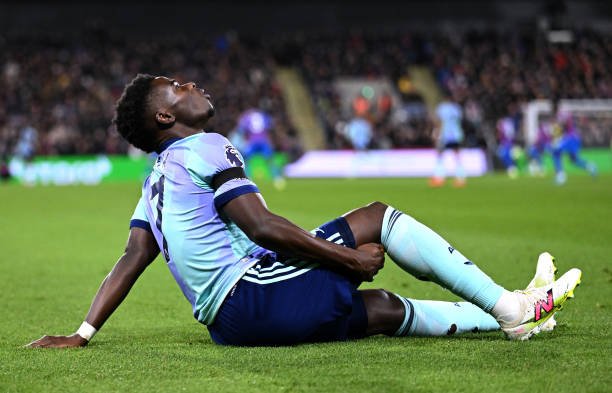
Saka’s Injury Is Not Bad Luck. It Is the Bill Coming Due for Football’s Unforgiving Calendar.
Arsenal fear Bukayo Saka could be out for up to two months with a quadriceps injury. Arteta says the signs are “not good.” But the real story is not the scan result—it is why this keeps happening to the same player.
Arsenal’s season just hit its first genuine crisis. Bukayo Saka, the club’s most important attacking player and the embodiment of everything Mikel Arteta has built, limped off ten minutes into Wednesday’s 2-2 Champions League draw at Bayern Munich . He felt a sharp pain in his left thigh after playing a routine pass with nobody around him . By Friday, Arteta was confirming the worst-kept secret in North London: Saka will miss Saturday’s Premier League clash with Everton, and Arsenal are bracing for a significant absence .
The early estimate is brutal. Arsenal fear a minimum of six weeks, potentially up to two months, with a grade-two quadriceps tear . Saka will miss Everton at the Emirates, the trip to Liverpool on October 31, and England’s Nations League fixtures against Croatia and Spain .
But the scan is not the story. The pattern is.
The Numbers Behind the Fragility
Saka is 25 years old. He should be entering his physical peak. Instead, he has suffered 11 different injuries since September 2023 . Hamstring surgery in December 2024 kept him out for 101 days . An Achilles issue in March 2026 cost him seven Arsenal games and disrupted his World Cup with England . A hip problem forced him out of a warm-up against Leeds in January 2026, keeping him out for 13 days and three matches. A hamstring strain sidelined him for four weeks .
Between 2021 and 2024, Saka missed just three Premier League matches and broke an Arsenal record by playing 83 consecutive top-flight games . He was the definition of durability. Now he is the definition of a player being ground down by the demands of modern football.
Arteta knows it. “It’s been muscles, it’s been tendons as well, which is something else,” he said on Friday . “He’s certainly been different in the last year or so, but the demands that go into the players are immense with club and international competitions, and the time between games is getting narrower. There are less than 66 or 67 hours between games” .
My Take: Arteta Is Right, But Arsenal Are Also Complicit
Here is where I step outside the press conference transcript and say what the club will not say publicly.
Arteta is correct about the calendar. The expansion of the Champions League, the bloated Club World Cup, the Nations League, the ever-growing international windows—these are not abstractions. They are minutes in a player’s legs and stress on a player’s tendons. Saka has played 49 games in a title-winning season, started a Champions League final, and featured at a World Cup, all while carrying a known Achilles issue that required careful management . That is not a schedule. That is a gamble.
But Arsenal are not innocent bystanders. Saka started 11 of Arsenal’s 12 games in all competitions this season before the Bayern injury . He was playing through the Achilles problem last season because Arsenal needed him to win the title. He was playing at the World Cup because England needed him. Every manager who has relied on Saka has done so because he is brilliant and because the alternatives are not as good. That is understandable. It is also how you turn a 22-year-old ironman into a 25-year-old with a recurring soft-tissue problem.
The question Arteta faced on Friday—whether Saka is “losing robustness”—was uncomfortable precisely because it is fair . The answer, stripped of diplomacy, is yes. Saka’s body is no longer absorbing the workload that once made him undroppable. That is not a character flaw. It is physiology.
What Arsenal Do Now
The immediate solution is Eberechi Eze. He replaced Saka in Munich and scored the opening goal, and Arteta was effusive in his praise: “I’m extremely happy with how Eze reacted to the previous game and the impact he had” . Noni Madueke, who scored the winner at Nottingham Forest last weekend, is expected to start on the right against Everton . Max Dowman, the 15-year-old prodigy, is “going to have minutes,” according to Arteta .
That is enough to beat Everton at home. It is not enough to win a Premier League title if Saka is out for two months. Arsenal are second, three points behind Manchester City . The trip to Liverpool on October 31 is already looming . November brings Chelsea, Newcastle, and a Champions League double-header. Saka’s absence will be felt most in the matches where Arsenal need a moment of individual brilliance to break a low block or punish a tired defence.
Eze can provide that. Madueke can provide that. But neither is Saka, and both have their own consistency questions. Arsenal’s squad depth is real, but depth is not the same as irreplaceability.
The Bigger Problem Nobody Wants to Solve
Saka’s injury is a warning that extends beyond the Emirates. The football calendar is not a natural phenomenon. It is a set of commercial decisions made by administrators who do not have to run the 67 hours between games . Players are being asked to produce more high-intensity minutes than their bodies can sustain. Saka is just the most visible example because he plays for Arsenal and England and because he never says no.
Arteta called for “support” from the governing bodies . He is unlikely to get it. The Champions League will expand again. The Club World Cup will grow. The Nations League will continue. The only thing that will change is the list of players in the treatment room.
Saka will return. He will be brilliant again. And then, if nothing changes, he will break again. That is not a prediction. It is a pattern.