

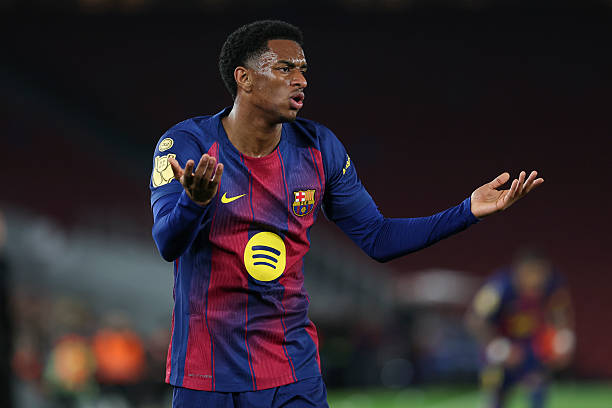
Introduction: The Transfer Story Shaking La Liga
The summer transfer window of 2026 promises to be one of the most turbulent in recent memory for FC Barcelona, and right at the heart of the storm sits a name that once represented the very best of La Masia’s production line. Alejandro Balde transfer speculation has intensified dramatically in recent weeks, with credible reports from across Europe suggesting that the La Liga leaders are now prepared to listen to substantial offers for one of their most dynamic players. What makes the Alejandro Balde transfer saga particularly compelling is the context: Barcelona are pursuing Inter Milan’s commanding centre-back Alessandro Bastoni as their defensive centrepiece for the next era, and financing that ambition may require offloading one of their own gems.
For a club that prides itself on nurturing homegrown talent, the very idea of departing with a La Masia graduate like Balde carries significant emotional and cultural weight. Yet football in 2026 is governed by economics as much as by sentimentality, and Barcelona’s sporting director Deco has made it abundantly clear that the club’s strategic goals will take precedence over nostalgic attachment. The Alejandro Balde transfer, should it materialise, would serve as a calculated funding mechanism — a means to an end in Barcelona’s relentless pursuit of Bastoni, a player Hansi Flick has reportedly identified as his ideal partner for Pau Cubarsí in the heart of the Blaugrana defence.
This deep-dive analysis examines every angle of the Alejandro Balde transfer story — from the player’s remarkable journey from the streets of Barcelona to the Camp Nou’s first team, to the clubs circling him with intent, to the financial mechanics that underpin this fascinating saga. We assess what his potential sale means for Barcelona’s squad architecture, how credible the Inter Milan and Manchester United interest really is, and what Balde himself might want from the next chapter of a career that has only just entered its most important phase.
1. The Alejandro Balde Story: From La Masia Prodigy to First-Team Mainstay
A La Masia Legacy Like Few Others
Alejandro Balde Martínez was born on October 18, 2003, in Barcelona, to a Bissau-Guinean father and a Dominican mother. His multicultural heritage has informed his character as much as his upbringing in the city he calls home. At just eight years of age — having already shown promise at city rivals Espanyol — Balde was snapped up by FC Barcelona’s legendary academy, La Masia, in 2011. What followed was one of the most decorated youth careers the academy has ever produced: league titles at every age group, from U10 right through to U19, with Balde almost always competing a year above his natural age group.
His explosive pace, left-footed precision, and natural ability to combine defensive duties with attacking forays made him the heir apparent to club legend Jordi Alba long before most pundits had even noticed his name. Balde made his first-team debut for Barcelona on September 14, 2021, replacing the injured Alba in a Champions League group stage match against Bayern Munich. Even in a 3–0 defeat at the Allianz Arena, the teenager’s composure under the most intense spotlight imaginable left observers thoroughly impressed.
The 2022–23 campaign was the one that truly put the Alejandro Balde transfer rumour mill into motion for the first time. Under Xavi Hernández, Balde became the undisputed first-choice left-back, displacing Alba — a true icon of the club — and earning a spot in Spain’s World Cup squad in Qatar in late 2022. His energy, work rate, and technical quality were on full display as Barcelona romped to the La Liga title, with Balde a consistent and vital presence throughout. He followed that up with a Spanish Super Cup victory, cementing his place as one of the most exciting young full-backs on the planet.
Injury Setbacks and the Road to Recovery
Just as Balde appeared ready to take the next step to genuine world-class status, fortune turned against him. In January 2024, playing against Athletic Club in the Copa del Rey quarter-finals, he suffered a serious hamstring injury in his right leg that required surgery and effectively ended his season. It was a devastating blow — not just to Barcelona’s ambitions, but to a 20-year-old who had only recently made the position his own. The images of Balde leaving the San Mamés pitch in tears resonated across the football world.
His recovery was painstaking but ultimately successful. By the start of the 2024–25 season, the Alejandro Balde transfer market interest had cooled somewhat, as clubs waited to see whether the player could return to his pre-injury form. He did — and then some. Balde was a key figure in Barcelona’s La Liga and Copa del Rey double that season, and his stunning goal in the 2025 Supercopa de España final against Real Madrid — Barcelona’s fourth in a 5–2 thrashing of their eternal rivals — served as an emphatic statement of intent. In the early months of 2025, in particular, Balde reached a level of performance that few left-backs anywhere in the world could match.
Yet the 2025–26 campaign has been more complicated. Another hamstring injury, this time sustained against Leganés in April 2025, kept him out of the crucial Champions League semi-final first leg against Inter Milan. His return for the second leg was a matter of near-desperate hope for Flick and the Barcelona coaching staff, reflecting just how indispensable the 22-year-old has become to the team’s system. By March 2026, he has made 20 La Liga appearances with 2 assists and a pass completion rate of over 91 percent, evidence that his quality remains undimmed even if consistency has proven elusive.
2. Why Barcelona Are Open to Selling Alejandro Balde
Deco’s Strategic Vision and the Bastoni Priority
The revelation that Barcelona would listen to offers for Alejandro Balde did not emerge in a vacuum. It is directly tied to the club’s most ambitious transfer target of the summer: Alessandro Bastoni, the 26-year-old Inter Milan centre-back who has established himself as arguably the finest ball-playing defender in Serie A and one of the top five defenders in European football. Deco, Barcelona’s sporting director, has made Bastoni his primary objective for the summer window, a desire confirmed by journalist Matteo Moretto on Radio MARCA. According to Moretto’s reporting, Deco sees Bastoni as the transformative defensive signing that could elevate Barcelona to a level capable of sustained Champions League success.
Bastoni’s profile is almost tailor-made for Barcelona’s style of play under Hansi Flick. Left-footed, supremely comfortable in possession, intelligent in his reading of the game, and experienced at the very highest levels of European football — he represents everything Flick craves in a partner for the teenage prodigy Cubarsí. The Barcelona coach has reportedly identified Bastoni as the ideal leader figure within the backline, a presence capable of organising and directing those around him in the way that club legends like Gerard Piqué and Carles Puyol once did.
The problem, as ever with Barcelona’s most coveted targets, is the price tag. Inter are demanding a minimum of €70 million for Bastoni, with some reports citing figures as high as €80–90 million. That represents a formidable financial commitment for a club that, despite having made significant strides in stabilising its finances through the controversial Levers of Economic Activity, still operates with a carefully managed transfer budget. Generating funds through player sales is therefore not merely desirable — it is likely essential.
The Camavinga Analogy: Strategic Sacrifice
Moretto’s framing of the Alejandro Balde transfer situation is instructive. He drew a direct parallel with Real Madrid’s treatment of Eduardo Camavinga — a hugely talented, club-developed player who is nonetheless considered sellable if the right offer arrives and the right incoming signing demands it. In Moretto’s words: the Alejandro Balde transfer could happen if a good offer arrives, just as the Camavinga situation at Madrid represents a player who is valued but not untouchable.
This is a significant statement from one of the most connected journalists in Spanish football. It signals a philosophical shift at Barcelona — a willingness to apply hard-nosed commercial logic even to academy graduates who have become genuine first-team contributors. The club, Moretto emphasised, has doubts about the continuity of Alejandro Balde moving forward, not because they disbelieve in his talent, but because his uneven performances and injury history create enough uncertainty to make a well-timed sale a rational option.
The financial arithmetic is compelling. If Barcelona can secure €50–60 million for Balde — a figure that matches his Transfermarkt valuation of approximately €59.9 million — and combine that with additional player sales or a player-plus-cash arrangement for Bastoni, the path to completing the deal becomes considerably clearer. The club has reportedly considered including players like Ronald Araújo in a potential Bastoni deal, though whether Inter would entertain such an arrangement remains uncertain.
Barcelona’s Contract Position and Release Clause
One factor that gives Barcelona significant leverage in any Alejandro Balde transfer negotiations is the contractual position. Balde signed a contract extension in September 2023 that keeps him at Camp Nou until June 2028, with a buy-out clause set at an astronomical €1 billion. That clause effectively makes any forced acquisition impossible — Barcelona will dictate the terms of any departure, and they will not be rushed into accepting a lowball offer.
The club’s official stance, according to multiple Spanish media outlets, is that Balde is not for sale and that they believe his performances will return to their peak level. This is the public position, as one would expect. Privately, however, the picture is more nuanced, with Moretto and others confirming that offers will be listened to if they are of sufficient quality. The existence of a €1 billion release clause means Barcelona hold all the cards — any Alejandro Balde transfer will happen strictly on their terms, at a price they consider fair, and only if the incoming replacement adequately fills the void.
3. Inter Milan’s Interest in Alejandro Balde: What We Know
The Nerazzurri’s Left-Back Puzzle
Inter Milan’s interest in the Alejandro Balde transfer saga is both logical and somewhat ironic, given that Barcelona’s pursuit of Bastoni is directly linked to Balde’s potential availability. The Nerazzurri, according to reports from 365 Scores and Fichajes, have been monitoring Balde closely as they consider their own positional needs heading into the summer window. Their primary left-back, Federico Dimarco, is under contract until 2027 and represents one of the finest players in his position in European football — but with uncertainty surrounding his long-term future at the club, Inter are exploring alternatives.
Balde’s profile is extremely appealing from an Inter perspective. At 22, he is already a full Spain international with Champions League experience, a World Cup appearance on his CV, and the kind of explosive pace and technical quality that would integrate seamlessly into the tactically sophisticated system employed at the San Siro. His ability to contribute offensively — providing consistent width, delivering quality crosses, and creating overloads in wide areas — fits perfectly into the overlapping full-back role that has been a cornerstone of Inter’s success in recent seasons.
Reports from Fichajes indicate that Inter had a previous offer of close to €50 million emphatically rejected by Barcelona months ago. That rejection reinforced the sense that any Alejandro Balde transfer to Inter would require a substantially more generous proposition — one that exceeds the player’s Transfermarkt valuation of approximately €60 million and reflects the genuine quality and long-term potential of a 22-year-old Spanish international.
The Competitive Dynamic: Inter Bidding for Balde While Barcelona Want Bastoni
Perhaps the most intriguing dimension of this entire Alejandro Balde transfer story is the competitive dynamic it creates between Barcelona and Inter. Here are two clubs who are simultaneously rivals in the Champions League, fierce competitors in the transfer market, and potential buyer and seller in the same window. Inter are pursuing Balde while resisting Barcelona’s advances for Bastoni. Barcelona are pursuing Bastoni while considering selling Balde — potentially to Inter itself.
This creates a fascinating negotiating landscape. Could a Balde-for-Bastoni swap deal ever materialise? The football logic is there — both clubs get a player they want, and the financial gap might be bridged through additional cash supplements. The practical obstacles are considerable: Inter would need to accept that Bastoni’s value significantly exceeds Balde’s, and the Nerazzurri have shown no inclination to accept a straight swap. But in football’s summer theatre, stranger deals have been done.
More realistically, the two transactions are likely to be handled independently. Barcelona will seek the best possible fee for Balde on the open market, using the proceeds to fund their Bastoni pursuit. Inter will assess whether the Alejandro Balde transfer represents better value than their alternatives, including a potential new contract and extended stay for Dimarco, or a move for a different player entirely.
4. Manchester United’s Rival Bid: INEOS Enters the Race
United’s Left-Back Predicament
Alongside Inter Milan, Manchester United have emerged as serious competitors in any potential Alejandro Balde transfer. The Red Devils, under the ownership of INEOS and currently operating under new manager Michael Carrick after the departure of Ruben Amorim, have identified left-back as one of their priority areas for reinforcement this summer. The chronic injury problems of Luke Shaw have left United vulnerable down the left side for much of the past two seasons, and Carrick’s tactical preference for an energetic, attack-minded full-back makes Balde an obvious target.
Reports from TEAMtalk and The Peoples Person indicate that United have been scouting Balde extensively and are prepared to table an opening offer in the region of €40 million. That figure, however, falls considerably short of both Barcelona’s valuation and what Inter are understood to be willing to pay, leading analysts to question whether United’s bid is genuinely competitive or a speculative enquiry designed to test the waters. Balde’s profile — described as a skilful speedster capable of offering a constant threat on the overlap — is well-suited to the kind of direct, high-tempo football Carrick has been implementing at Old Trafford following their surprisingly strong second half of the season.
The Jorge Mendes Factor
One element of the Alejandro Balde transfer picture that has drawn significant attention is the involvement of his agent, Jorge Mendes — the most powerful figure in football representation, whose clients include Cristiano Ronaldo and a host of the game’s biggest stars. Mendes has an established and warm relationship with Barcelona president Joan Laporta, having brokered multiple deals involving the club in recent years. His visit to Barcelona in recent weeks, reported by the Spanish media, inevitably sparked speculation that negotiations regarding Balde’s future may already be underway at some level.
Crucially, Mendes also has strong connections with both Inter Milan and Manchester United, giving him the theoretical ability to facilitate any Alejandro Balde transfer with maximum efficiency. The fact that PSG enquired about Balde a couple of years ago — as noted by Moretto — and that Mendes counts the Paris club among his influential networks, suggests that the pool of potential suitors for the Spanish international could yet widen further as the summer approaches.
Manchester United‘s INEOS leadership, for their part, are known for their analytical and data-driven approach to recruitment. Balde’s metrics — a pass completion rate exceeding 91 percent, strong expected assist output, and the kind of progressive carrying statistics that define modern attacking full-backs — would rank highly in their models. The question is whether United are willing to engage in a bidding war that could see the Alejandro Balde transfer fee escalate well beyond their initial budget, particularly given their simultaneous focus on midfield investment.
5. Alejandro Balde’s On-Pitch Profile: Why He Commands Such Attention
Technical Attributes and Playing Style
To understand why the Alejandro Balde transfer market is so active, one must appreciate the sheer quality of what is on offer. Balde is not merely a competent left-back — he is, on his best days, a genuinely elite operator in one of the most demanding positions in modern football. His pace is exceptional, regularly measured among the fastest in La Liga, and he combines that physical attribute with outstanding close control and the ability to navigate tight spaces at high speed.
In possession, Balde is remarkably assured for his age. His pass completion rate of over 91 percent in La Liga this season speaks to his composure and intelligence when receiving and distributing the ball. He plays 1.26 key passes per game — a figure that places him above 84 percent of La Liga defenders — and his expected assists output of 0.22 per 90 minutes reflects his consistent ability to create genuine scoring opportunities from the left flank. WhoScored rates his dribbling as Very Strong and his passing as Strong, with a notable tendency to maintain short, precise combinations that align perfectly with Barcelona’s positional play philosophy.
Defensively, Balde remains a work in progress. His 1.76 tackles per 90 minutes and 0.38 interceptions per 90 minutes are reasonable rather than exceptional figures, and there have been occasions this season — most notably in the Copa del Rey semi-final against Atlético Madrid — where his positioning and defensive concentration have been found wanting against high-quality opponents. Critics have pointed to these moments as evidence that the Alejandro Balde transfer talk is not entirely misplaced from Barcelona’s perspective, arguing that the club may benefit from a more defensively secure option on the left side.
The Injury Question: An Unavoidable Concern
For any club considering an Alejandro Balde transfer, the injury record cannot be ignored. Two significant hamstring injuries in the past two years — both requiring extended recovery periods and one necessitating surgery — introduce a real element of risk into any valuation. Hamstring injuries in footballers are notoriously prone to recurrence, particularly when players push themselves to return too quickly or do not allow complete muscular rehabilitation.
Barcelona’s own medical staff have reportedly been cautious in managing Balde’s returns from these setbacks, recognising that the long-term cost of a rushed comeback far outweighs the short-term benefit of having him available for any individual match. The decision to hold him out of the Champions League semi-final first leg against Inter in 2025, despite intense pressure to include him, was widely praised as the correct call. Yet the fact that this is now the second time in as many seasons that a significant hamstring problem has interrupted his campaign will inevitably feature prominently in the due diligence of any club pursuing an Alejandro Balde transfer.
Clubs like Inter Milan, with their sophisticated medical and sports science departments, will conduct exhaustive assessments of Balde’s physical profile before committing to a fee that could exceed €60 million. Any indication that the injuries represent a structural vulnerability rather than bad luck could significantly affect the final transfer fee — or indeed whether the deal happens at all.
Comparative Rankings Among European Left-Backs
At his peak, the argument for the Alejandro Balde transfer being worth €60 million or more is compelling. In a landscape where top-quality left-backs command extraordinary fees — Ferdi Kadioglu, Theo Hernandez, and Alphonso Davies have all been valued in the €60–80 million range in recent windows — Balde’s combination of youth, technical excellence, international pedigree, and attacking threat places him firmly in the elite tier. His FotMob average rating of 7.2 in La Liga this season reflects consistent if not spectacular contribution.
The comparison with Federico Dimarco at Inter is instructive. Both are left-footed, offensively dynamic, technically gifted full-backs with strong international records. Dimarco, at 27, is arguably more consistent defensively and brings greater experience of high-stakes European football, but Balde — five years Dimarco’s junior — has the potential ceiling and the physical tools to develop into something even more complete over the next five years. It is that long-term upside that makes the Alejandro Balde transfer story so compelling to the clubs involved.
6. Barcelona’s Transfer Strategy: The Bastoni Masterplan
Alessandro Bastoni: Why He Is the Chosen One
To fully contextualise the Alejandro Balde transfer saga, it is necessary to understand why Bastoni matters so much to Barcelona. The Inter centre-back, born in 1999 and now 26 years of age, has spent the majority of his career at Inter and developed into one of the most complete defenders in European football under a succession of top managers. He is the consummate modern centre-back — left-footed, commanding in the air, exceptional in his distribution, and possessing the tactical intelligence to operate effectively in any defensive system.
Hansi Flick’s Barcelona have faced real challenges at centre-back this season. The partnership of Pau Cubarsí and Eric García has been functional but limited, and the absence of a natural left-sided partner for the supremely talented Cubarsí has been identified as a structural weakness. Bastoni would resolve that issue at a stroke, providing not just defensive quality but genuine leadership and European experience in a team that is still learning how to compete at the very highest level of the Champions League.
According to reporting from La Gazzetta dello Sport, Inter have now removed Bastoni from their previously held non-transferable list, indicating that a summer departure is at least theoretically possible if Barcelona — or indeed other interested parties including Liverpool, Arsenal, and Manchester City — can meet their valuation. Inter are thought to require a minimum of €70 million, with some Italian sources citing €80 million as the true asking price. For Barcelona to finance such a move, generating significant transfer income is essential.
The Financial Equation: Can Barcelona Make It Work?
Barcelona’s ability to spend in the summer window is constrained by La Liga’s financial fair play rules and the club’s ongoing debt management programme. The so-called Levers — asset sales that generated significant cash in recent years — have provided some breathing room, but the club cannot simply spend at will without generating corresponding income. The sale of Alejandro Balde at a fee of €55–65 million would represent a significant contribution to the Bastoni fund and could potentially be the difference between the deal being viable or not.
The club’s hierarchy has been transparent about this reality. With Marcus Rashford’s permanent transfer from Manchester United already in progress at a reported €30 million fee, and a new striker also on the summer wishlist, Barcelona’s transfer budget faces serious demands. Journalist Fabrizio Romano has confirmed that Bastoni remains the dream defensive target but that the deal’s viability depends entirely on what the club can generate through sales. The Alejandro Balde transfer, in this context, is not merely a peripheral news story — it may be the linchpin of Barcelona’s entire summer strategy.
The club is also understood to be exploring cheaper alternatives to Bastoni — including FC Twente’s Ruud Nijstad and cheaper loan options — as contingency planning. But the preference is clear. Deco wants Bastoni. Flick wants Bastoni. And to get Bastoni, Barcelona may well need to say goodbye to Alejandro Balde.
7. What Does Balde Want? The Player’s Perspective
A Barcelona Boy at Heart
Perhaps the most emotionally complex element of the Alejandro Balde transfer discussion is the player’s own perspective. Born and raised in Barcelona, a product of the club’s academy from the age of eight, a man who has spoken repeatedly about his love for the shirt and his ambition to write his name into the club’s history — Balde is not a player who would relish the prospect of being sold as a financial instrument. His contract, extending until 2028 with that famously sky-high €1 billion release clause, was signed in September 2023 as a clear statement of mutual commitment.
Yet football is not a game of sentiment, and Balde — represented by the supremely pragmatic Jorge Mendes — will be receiving realistic assessments of his situation. If Barcelona decide that the Alejandro Balde transfer is in their best interests, the player will have limited leverage to resist, though he would of course need to agree personal terms with any buying club. What Mendes will be advising, almost certainly, is that his client should remain open to a move if the right opportunity presents itself at the right club — and that a well-managed departure at 22, while still developing, could serve his long-term interests better than remaining as a player whose position at Camp Nou is no longer entirely guaranteed.
The Flick Conundrum: Trust But Uncertainty
Hansi Flick has publicly backed Balde on multiple occasions, going as far as lobbying for his inclusion in the Spain national team squad and defending the player’s performances even during difficult patches this season. That public support is genuine and means something. But the private signals — Balde being dropped for the Girona match in favour of Gerard Martín, the club’s willingness to listen to offers, the question marks raised by his inconsistency — paint a more complicated picture.
The Alejandro Balde transfer question, for the player himself, may ultimately come down to a simple choice: fight for his place at Barcelona in a context where the club’s long-term direction appears to involve significant defensive restructuring, or embrace a move to a club — whether Inter, United, or another — where he would be unequivocally the first-choice left-back and able to develop his game free from the kind of scrutiny and pressure that comes with representing Barcelona at the highest level.
At 22, Balde is at precisely the age where such career-defining decisions matter most. The next two or three years will determine whether he develops into a genuine world-class left-back or plateaus as a very good but not exceptional player. The choice of club and environment in that window will be critical.
8. Barcelona’s Alternatives: Life After Balde
Gerard Martín: The Ready-Made Replacement?
If the Alejandro Balde transfer does go through, Barcelona will need a plan for the left-back position. The most obvious internal option is Gerard Martín, the 23-year-old who has deputised admirably for Balde during his injury absences this season. Martín is contracted until 2028 with a €100 million release clause, reflecting Barcelona’s genuine belief in his long-term potential. His performances against Real Valladolid in La Liga earned positive reviews, though his struggles against Denzel Dumfries in the Champions League semi-final first leg highlighted the gap that still exists between him and the very top level.
The club also has the 19-year-old Jofre Torrents in the academy pipeline, regarded as one of the most exciting young full-backs in Spain. But throwing a teenager into the role vacated by an established Spanish international would represent a significant risk, particularly in a season when Barcelona will almost certainly be competing on multiple fronts.
Alejandro Grimaldo: The Wildcard Option
One left-field possibility that has been circulating in the Barcelona rumour mill is a return for Alejandro Grimaldo, the former La Masia graduate who departed the club as a teenager and subsequently rebuilt his career at Benfica and Bayer Leverkusen into one of the finest attacking full-backs in European football. Grimaldo’s contract with Leverkusen runs until 2027, and his previous association with Barcelona gives the move an obvious narrative appeal. Whether the financial and sporting terms could be aligned is another question, but the Grimaldo option represents a genuinely intriguing possibility in the event of an Alejandro Balde transfer departure.
9. The Broader Context: Barcelona’s Summer Revolution
The Alejandro Balde transfer story does not exist in isolation. It is one thread in a much larger tapestry of transformation that Barcelona are planning for the summer of 2026. The club, currently leading La Liga and having shown genuine Champions League credentials under Hansi Flick, believe they are on the verge of a period of sustained dominance — but that achieving that dominance requires targeted investment in a handful of world-class players.
In addition to Bastoni, Barcelona have been linked with new forward options — a direct consequence of Ferran Torres’ inconsistency as a centre-forward option in Robert Lewandowski’s absence. The Polish striker, turning 38 this summer, cannot be expected to lead the line alone for much longer, and the question of who leads Barcelona’s attack in the post-Lewandowski era is one of the most pressing facing Flick and Deco as they plan ahead.
Against this backdrop, the Alejandro Balde transfer represents one piece of a complex jigsaw. Getting it right — securing the maximum possible fee while ensuring appropriate cover in the position — will require careful management, skillful negotiation, and a degree of fortune. Barcelona have shown they are capable of navigating precisely such complexities in recent windows. The question is whether the Balde situation will resolve smoothly or evolve into the kind of protracted saga that has occasionally undermined the club’s summer planning in the past.
What is clear is that the La Liga leaders are not operating from a position of desperation. They hold a €1 billion release clause, a willing but not eager seller’s posture, and the knowledge that multiple top European clubs want their player. In transfer market terms, that is about as strong a position as any club can occupy. The Alejandro Balde transfer, if and when it happens, will happen on Barcelona’s terms.
10. Transfer Valuations: What is Alejandro Balde Actually Worth?
Current Market Assessments
Establishing a fair market valuation for any player in the modern game is an imprecise science, but in the case of the Alejandro Balde transfer, several independent assessments provide a useful framework. Transfermarkt, the most widely cited independent valuation platform, currently places Balde’s market value at €59.9 million — a figure that reflects both his quality at his best and the uncertainty created by his injury record and inconsistent form over the past 18 months.
Manchester United’s reported opening gambit of €40 million falls significantly short of this figure and would be unlikely to prompt serious consideration from Barcelona. Inter’s previous rejected offer, described as being close to €50 million, is closer but still below the threshold that would compel the Spanish club to engage substantively. Most observers believe the true market-clearing price for an Alejandro Balde transfer sits in the €55–65 million range — a significant sum that would give Barcelona a meaningful contribution toward their Bastoni fund while fairly compensating them for a player they have developed from the age of eight.
The Age Premium and Development Curve Argument
One argument for valuing the Alejandro Balde transfer even more generously than current valuations suggest is the age premium. Balde turned 22 only in October 2025. Elite left-backs typically reach their physical and technical peak between the ages of 25 and 29, meaning the buyer of Balde today is effectively purchasing the best years of his career. The clubs in pursuit — particularly Inter, who are known for their astute long-term squad planning — will be making exactly this calculation in their models.
If Balde can resolve his injury issues and return consistently to the form he showed in the first half of 2025, a club paying €60 million today could find themselves owning a €100 million-plus asset in three years’ time. That potential appreciation is precisely why Inter, Manchester United, and other clubs are willing to engage in a potentially heated bidding war, and why Barcelona have no reason to accept anything below full market value.
11. Expert Opinions and Media Reactions
Matteo Moretto’s Assessment
Journalist Matteo Moretto, whose access to Barcelona’s inner circles makes him one of the most reliable sources on Blaugrana transfer matters, has been consistent in his messaging about the Alejandro Balde transfer situation. His core thesis — that Barcelona would listen to offers and that Balde is not untransferable — has been corroborated by subsequent reporting from multiple other outlets, lending it significant credibility. Moretto’s comparison with the Camavinga situation at Real Madrid is particularly telling: it frames Balde not as a player being forced out, but as one whose departure is genuinely contemplated as part of a rational sporting and financial strategy.
Fabrizio Romano’s Contribution
Italian journalist Fabrizio Romano — the global standard-bearer for transfer reporting — has confirmed the concrete nature of Barcelona’s Bastoni interest while flagging the financial challenges involved. His reporting underscores the dependency between the two deals: Bastoni’s arrival is contingent on generating sufficient income from sales, and the Alejandro Balde transfer is the most logical mechanism for doing so. Romano has not yet reported a formal offer or bilateral discussions, but the trajectory of his reporting suggests that meaningful talks are likely to intensify as the summer approaches.
12. Timeline: Key Dates and What to Expect
The summer transfer window officially opens in late June 2026 and runs through to the end of August. In practice, however, the deals that shape any window are largely agreed in principle months beforehand, with formal completion following when the window opens. Given that Barcelona’s interest in Bastoni is already firmly established and the Alejandro Balde transfer has been publicly acknowledged as a possibility, the relevant timeline looks something like this:
March–April 2026: Informal soundings continue. Barcelona assess Balde’s form over the run-in while Deco maintains contact with Bastoni’s representatives and Mendes explores the market for Balde. Inter and Manchester United continue their monitoring.
May 2026: End-of-season assessments. Barcelona determine their final La Liga and Champions League outcomes, which will influence the scale of their summer investment. If they win La Liga and advance deep into the Champions League, the pressure to invest heavily increases. The Alejandro Balde transfer, if pursued, is likely to be formally offered to the market.
June 2026: Window opens. Formal negotiations accelerate. Barcelona will seek to agree terms with a buying club — most likely Inter or United — while simultaneously advancing discussions with Inter over Bastoni. Personal term negotiations with Balde’s camp begin in earnest.
July–August 2026: Deal completion. The Alejandro Balde transfer, if it happens, is most likely to be formally announced in this period, with Bastoni’s arrival contingent on or closely tied to it.
Conclusion: The Alejandro Balde Transfer and Barcelona’s Crossroads Moment
The story of the Alejandro Balde transfer is, at its core, a story about modern football’s relentless demands and the difficult choices they force upon even the most romantically inclined clubs. Barcelona — a club whose identity is built on the ideal of developing and retaining homegrown talent — finds itself contemplating the sale of a 22-year-old La Masia graduate not because he has failed, but because success requires resources that can only be generated through exactly this kind of calculated sacrifice.
Alejandro Balde transfer speculation will only intensify in the coming months, driven by Barcelona’s transparent need to fund the Bastoni deal, the genuine and competitive interest from Inter Milan and Manchester United, and the broader summer revolution that Hansi Flick and Deco are orchestrating at Camp Nou. What happens to Balde — whether he stays and rediscovers his very best form, or departs for a new challenge that allows him to develop away from the relentless spotlight of the world’s most scrutinised club — will be one of the defining subplots of the 2026 transfer window.
For Barcelona, the stakes are high. Getting the Alejandro Balde transfer right — maximising the fee, identifying the right replacement, and using the proceeds wisely — could be the difference between a summer that launches a new period of genuine European dominance and one that represents another missed opportunity. For Balde himself, the next few months may prove the most consequential of his life: a moment when the choices he and his representatives make will shape not just his career, but the legacy he leaves at the club he has called home since childhood.
The Alejandro Balde transfer saga is far from over. But one thing is already certain: the La Liga leaders are no longer treating their Academy gem as untouchable — and European football’s biggest clubs have taken notice.


