

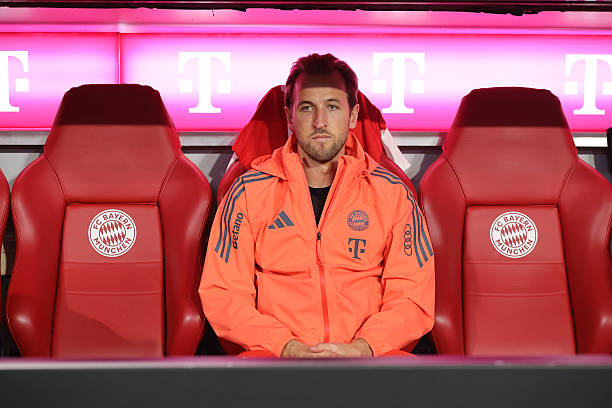
Introduction: The Extraordinary Scene at the Gewiss Stadium
When Bayern Munich’s official starting line-up landed in inboxes and on screens across the world on the evening of Tuesday, March 10, 2026, the reaction was immediate and universal. Harry Kane — 109-goal scorer across all competitions in his Bayern career, the player signed for £100 million to be the centrepiece of a Treble-chasing era at the Allianz Arena — was not in the starting eleven for a Champions League round-of-16 first leg at Atalanta. He was on the bench. For the second game in a row.
Harry Kane benched is, in the context of his Bavaria career, an arresting headline. Since his arrival from Tottenham Hotspur in the summer of 2023, the England captain has been the default, irreplaceable number nine for virtually every competitive match in which Bayern have had him available. He has broken records, won individual awards, and led the line with the kind of relentless goalscoring efficiency that made him the most expensive British transfer in history. The idea of the England captain on the bench for any reason other than the most serious injury concern represents a genuinely unusual news event.
Yet here were the facts, confirmed by Vincent Kompany before kick-off at the Gewiss Stadium: Kane had trained only once following a calf injury sustained in training ahead of the previous Friday’s Bundesliga clash against Borussia Mönchengladbach, and that single session was insufficient to guarantee his readiness to start a high-intensity Champions League knockout fixture. “He’s trained once and for sure he can play a role today,” Kompany told Prime Video. “We’re happy that he’s with us today. It was too early for a start but he can play a role today nevertheless and that’s positive for us today.”
In Kane’s place, for the second consecutive match, stepped Nicolas Jackson — the 24-year-old Senegalese striker on loan from Chelsea whose form over the past three months has transformed from a pleasant surprise into a genuinely compelling story. Jackson had already put in a solid performance in Bayern’s 4–1 win over Borussia Mönchengladbach, a game in which he started as Kane’s replacement. And now, in a Champions League first leg at one of Serie A’s most physical and tactically sophisticated sides, Kompany was backing him again.
This comprehensive analysis unpacks the Harry Kane benched story in full — the injury details, the tactical rationale, Jackson’s extraordinary career arc, the precedent set by Kane’s earlier season substitute spell, and what it all means for Bayern’s Champions League ambitions as the knockout stages intensify.
1. The Harry Kane Benched Decision: Understanding the Injury Context
The Calf Problem: Familiar Territory
The specific injury that has placed Harry Kane on the bench for consecutive games is a calf knock — sustained not in a match but in training in the days leading up to Bayern’s Bundesliga fixture against Borussia Mönchengladbach on Friday, March 6. Kompany confirmed that Kane took a hit to his calf and couldn’t shake it off in time for the Gladbach clash. The nature of the injury — an impact blow rather than a muscular strain — is important context.
An impact calf injury is generally considered less serious in terms of structural tissue damage than a muscular tear, but the residual sensitivity and the risk of exacerbation through high-intensity movement made Kompany understandably cautious about deploying his primary striker in a physical Champions League encounter at altitude against Atalanta’s notoriously combative pressing system.
The timing was particularly frustrating because Kane had been in extraordinary form prior to the injury. Kane scored twice in Bayern’s win over Borussia Dortmund, reaching 45 goals this season and breaking three historic milestones. A man scoring goals at that kind of rate — and with those kinds of records being broken — is the last player any manager wants to lose, even temporarily. The decision to leave him out for the Atalanta first leg was not taken lightly.
This omission becomes even more significant when you consider the context of the Champions League round of 16. This is not a routine Bundesliga fixture where rotation is conventional and the cost of defeat is manageable. A first leg in Italy, against a side that had eliminated Borussia Dortmund from the Champions League twelve months earlier with a 4–1 victory, represents exactly the kind of high-stakes environment where Bayern would ordinarily want their most important player starting from the first whistle.
Kompany’s Wednesday Press Conference: Cautious Optimism
Kompany had been cautiously optimistic at the pre-match press conference on Monday, saying: “Harry Kane got through training very well today” while adding: “We still have to make a decision about what is best for tomorrow. We want to wait until tomorrow morning to see how he has coped with the training session.” The final determination — that one training session was not sufficient qualification for starting a Champions League knockout match — reflects the kind of athlete management philosophy that Kompany has applied consistently throughout his tenure at the Allianz Arena.
It also reflects the specific physical demands of Atalanta under their current manager. Atalanta’s system, built around high-pressing, physical duels, and the kind of intense man-marking that tests every inch of a striker’s physicality, is one of the most demanding environments in European football for a centre-forward to operate in. Asking Harry Kane to start that game having completed only one training session following a calf knock would have been a significant physical gamble — and Kompany, to his credit, chose patience over risk.
The precedent of Manuel Neuer’s situation was also instructive. Neuer had gone off at halftime in the Friday win over Gladbach with a tear in his left calf — the same injury he had suffered the month before — and Jonas Urbig was starting in his place at Atalanta. With their captain and goalkeeper already absent through injury, asking a striker to play through a calf knock in the same game carried a compounded risk that made the bench decision even more defensible in retrospect.
2. This Is Not the First Time: Kane’s Earlier Substitute Spell This Season
The Stuttgart Hat-Trick: A Blueprint From December
The bench call of March 2026 has a direct precedent from earlier in the season — one that, in retrospect, makes the current situation considerably less alarming than first impressions might suggest. In December 2025, Kane was named as a substitute for Bayern’s Bundesliga clash at VfB Stuttgart, a decision that raised eyebrows at the time. He came on after 60 minutes, replacing Jackson who was unable to find the back of the net, and proceeded to score a hat-trick in 30 extraordinary minutes.
The Stuttgart episode established several important precedents that are directly relevant to the current situation. First, it demonstrated that Kane — whatever his feelings about starting on the bench — is capable of making a transformative impact as a substitute. Speaking after the Stuttgart game, Kane said: “It’s something I’m not used to, but I did it a couple of times this season. The boss wanted to keep me fresh and save energy.” His acceptance of the role, even while acknowledging the unfamiliarity of it, speaks to a professionalism and collective-first mentality that has characterised his entire career.
Second, and perhaps more importantly, it revealed Kompany’s thinking about how to manage Kane’s minutes through congested fixture periods. When asked about the Stuttgart decision, Kompany said: “I had this change in mind before the game started. We have four games in 11 days. If I start Harry every game and he plays 90 minutes, I’ll get questions about why he always plays.” The rotation logic — protecting Kane from the cumulative physical toll of consecutive 90-minute starts in a fixture-heavy period — is sound squad management, and the Stuttgart hat-trick outcome proved it worked.
By the time of the Atalanta match, Kane’s total for the season stood at an extraordinary level. His hat-trick against Stuttgart meant he had bagged 28 goals in 22 games in all competitions, a figure that had subsequently grown to reach 45 goals across the season by the Dortmund Klassiker. The player sitting on the bench at Atalanta is a player who has been scoring at a rate that most strikers in football history would envy.
3. Nicolas Jackson: The Man Who Has Made Harry Kane Benched Plausible
From Chelsea Loanee to Bundesliga Starter
The story of Nicolas Jackson at Bayern Munich is one of the more compelling secondary narratives of the 2025–26 European football season. The 24-year-old Senegalese striker arrived at the Allianz Arena on loan from Chelsea in September 2025 with a reputation as a technically gifted, physically dynamic forward with a sharp eye for goal — but also with question marks about his consistency and his ability to perform at the level demanded by a club with Bayern’s Champions League ambitions.
Jackson had scored 14 Premier League goals in his maiden Chelsea season and was part of the teams that won the UEFA Conference League and FIFA Club World Cup in 2025, demonstrating his capacity to contribute in high-stakes environments. Yet Chelsea’s decision to loan him to Bayern suggested either that the Blues believed he needed a different environment to maximise his potential, or that his place in Enzo Maresca’s system was less secure than his ability warranted. Either way, the move to the Bundesliga represented an opportunity that Jackson has seized with impressive conviction.
According to his official Bayern Munich profile, Jackson can play either through the middle or out wide and is known for his technique, speed and finishing. These are precisely the attributes that make him a viable alternative to Kane in Bayern’s system — not a like-for-like replacement, since no striker in world football is truly like-for-like with Kane, but a functional and dynamic option capable of leading the line with purpose and energy.
Jackson’s Stats: Good Enough to Keep Harry Kane Benched
The statistical case for Jackson’s form is reasonably compelling if not yet spectacular. Across 16 Bundesliga appearances in 2025–26, Jackson has scored 4 goals with no assists, contributing to a Bayern squad that has been dominant in the German top flight. In the Champions League, his record stands at 3 goals and 3 assists in 7 appearances — a more impressive European contribution that speaks to his ability to perform on the biggest stages.
The goal-scoring numbers are not individually spectacular by the standards that a striker at Bayern Munich is expected to meet. But they represent something specific and valuable in the context of the Harry Kane benched situation: they are sufficient. Jackson has been good enough to merit his place on those occasions when Kane has been unavailable or managed out of the starting line-up, and his performances — particularly in the wide attacking role that Kompany’s system sometimes deploys him in — have been characterised by the intensity and physical commitment that the manager prizes above individual output metrics.
Gnabry, speaking about his own role in the absence of Kane, was clear about what Jackson brings: “He will stand in for Harry and also bring his style of play into the game.” That acknowledgement — from a teammate of significant experience — that Jackson has a defined style, a recognisable game, and genuine value for Bayern reflects the esteem in which the squad holds the Chelsea loanee.
The Penalty Snub: A Revealing Tactical Detail
One of the more interesting subplots is the question of who takes penalties in the England captain’s absence. In the absence of Kane, who is the undisputed first-choice penalty taker, Bayern’s coaching staff had already designated a secondary and tertiary list, with Jackson — despite his hunger for goals — not at the top of that list for specific fixtures.
The penalty arrangement reveals the careful hierarchy that exists within Bayern’s squad even on those occasions when the substitution headline emerges. Kane’s authority as the designated set-piece specialist — particularly from the penalty spot, where his record is outstanding — does not evaporate merely because he is not in the starting line-up. The protocols exist. The coaching staff has planned for his absence. And Jackson, for all his quality, operates within a framework that acknowledges Kane’s primacy even when Kane himself is watching from the dugout.
Kompany was quick to defend Jackson publicly, dismissing any rumours of discontent and emphasising that the decision had nothing to do with Jackson’s talent, but everything to do with the environment he wants to create for the young striker. His protection of the Chelsea loanee speaks to a broader managerial philosophy of creating psychologically safe conditions for younger players to develop — even in a club of Bayern’s demanding standards.
4. The Atalanta Context: Why the Venue Made Harry Kane Benched More Complex
The Gewiss Stadium: A Fortress That Broke Dortmund
The context in which Harry Kane benched became the story for this specific match adds an additional layer of complexity. Atalanta at the Gewiss Stadium represent one of the most daunting away fixtures in European football, a combination of atmosphere, pressing intensity, and tactical specificity that has broken teams of considerable quality across multiple Champions League campaigns. Gnabry explicitly referenced the Dortmund humiliation — a 4–1 defeat for Borussia Dortmund in the previous season’s Champions League — as a scenario Bayern wanted to avoid.
Bayern’s starting line-up for the first leg read: Urbig; Stanisic, Upamecano, Tah, Laimer; Kimmich, Pavlovic; Olise, Gnabry, Luis Diaz; Jackson. The inclusion of Olise, Gnabry, and Luis Diaz around Jackson gave Kompany’s side pace, technical quality, and multiple goal threats — a recognition that relying solely on a striker coming off a calf injury would be strategically risky. Jackson as the focal point of that attack was both a tactical choice and a concession to Kane’s physical limitations.
Atalanta’s system demands specific physical resilience from opposing strikers — the centre-backs are aggressive and physical in their defensive approach, the pressing triggers are well-drilled, and the transition play can punish any striker who gives less than maximum effort in holding the ball up and linking play. These are aspects of the game where Jackson’s pace and energy, while different from Kane’s more complete skill-set, offer genuine compensatory value.
What Happened: Kane’s Substitute Impact
The match at Bergamo ended with Kane coming off the bench — his presence in the second half adding a different physical and technical dimension to Bayern’s attacking play. The bench story did not, in that sense, produce a Stuttgart-style hat-trick encore. But his availability as an impact substitute — and the threat his introduction represents to any defence that has been managing Jackson for 60 or 70 minutes — is itself a significant weapon in Kompany’s tactical arsenal.
The outcome of the first leg, regardless of the scoreline, confirmed the central dynamic: Bayern are a better team with Kane starting, but they are not a diminished team when Jackson leads the line. The Chelsea loanee’s form has created a genuine dilemma for when Kane does return to full fitness — a pleasant problem for Kompany to have, but a genuine one nonetheless.
5. Harry Kane: The Career That Makes Harry Kane Benched So Jarring
A Record-Breaking Career That Continues to Rewrite History
To fully appreciate why Harry Kane benched generates such widespread reaction, it is necessary to contextualise what the 32-year-old has achieved since arriving in Bavaria in the summer of 2023. The fee — £100 million, making him the most expensive British footballer in history — reflected the scale of Kane’s achievement as arguably the most complete centre-forward of his generation. His Premier League record at Tottenham — 280 goals in 435 appearances — made him the all-time leading scorer in the history of that club and placed him second on the all-time Premier League scorers list behind Alan Shearer.
At Bayern, he has surpassed all expectations. The 45 goals in a single season that he reached against Borussia Dortmund represent form that places him in the company of the very greatest strikers in the club’s history. His hat-trick from the bench against Stuttgart, his Klassiker brace, his consistent Champions League contributions — the statistics of the 2025–26 season are those of a player operating at the absolute peak of his powers, not one whose physical condition should be a source of concern.
Which makes this situation, when it arises through injury, all the more frustrating from a Bayern perspective. The calf knock is minor and the prognosis is positive. But even a temporary disruption to the rhythm of a striker who scores as consistently as Kane represents a genuine tactical and psychological inconvenience for a club competing on four fronts.
The England Captaincy and World Cup Pressure
The Harry Kane benched situation at Bayern carries implications that extend beyond the Bundesliga and Champions League. As England captain and the focal point of the Three Lions’ hopes heading into the World Cup in the summer of 2026, any injury to Kane — however minor — is immediately elevated to a national news story in the United Kingdom. The English media’s attention to his calf problem has been considerable, with injury analysts and medical experts offering assessments of the timeline for recovery and the risk of recurrence.
For Gareth Southgate’s successor at the England helm, keeping Kane available and in form for the World Cup is the single most important individual management task of the next few months. England’s chances of ending 60 years of hurt and winning a World Cup are inextricably linked to Kane’s physical condition and confidence, and any sequence of matches — like the consecutive games as substitute that prompted the Harry Kane benched headlines — inevitably provokes concern among English football supporters.
Kane himself, throughout his career, has shown remarkable durability — a tribute to his own physical management and the sports science support structures at Tottenham and then Bayern. The calf knock of early March is not a significant injury, and the expectation of all parties is that he will return to full starting duty in the very near term. But the substitute narrative, however briefly it lasts, serves as a reminder that even the most robust of strikers remains vulnerable to the random misfortunes of professional sport.
6. Vincent Kompany’s Management Style: The Thinking Behind Harry Kane Benched
A Manager Who Trusts His Principles Over His Stars
Vincent Kompany’s management of the Harry Kane benched situation tells you a great deal about the Belgian’s managerial philosophy and the culture he has built at Bayern Munich since succeeding Thomas Tuchel in the summer of 2024. Kompany is not a manager who defaults to picking his biggest names regardless of physical condition or tactical context. He is a systems manager — a coach who believes that the right player in the right condition is more valuable than the biggest name playing at 80 per cent of his capacity.
His handling of the previous benched episode, against Stuttgart in December 2025, is the template. Kompany had emphasised that the plan to introduce Kane around the hour mark was in his mind before the game started, reflecting a deliberate and pre-meditated approach to managing his striker’s minutes through a congested schedule. The Stuttgart outcome — a Kane hat-trick from the bench — validated the philosophy spectacularly, and Kompany has evidently stored that lesson in his tactical thinking for exactly the kind of situation he faced at Atalanta.
The question of whether Harry Kane benched is ever a purely tactical decision — rather than an injury-necessitated one — is one that Kompany has handled with characteristic diplomacy. He is careful to frame decisions as injury-cautious rather than tactical choices about the merits of starting Kane versus Jackson. But the Stuttgart precedent, where rotation logic rather than injury concern was the stated rationale, suggests a manager who is comfortable making the bench call for multiple reasons.
Squad Harmony: Protecting Jackson’s Development
Kompany’s public protection of Jackson — emphasising that the penalty protocol decision had nothing to do with the loanee’s talent and everything to do with the environment the manager wants to create — reflects a sophisticated awareness of the psychological dynamics at play when a young striker is asked to fill the shoes of one of the world’s best.
Jackson, at 24, is at a formative stage of his career. His loan move to Bayern represents his first serious experience of Champions League football as a regular contributor, and the conditions under which he develops his confidence and game understanding will shape his trajectory for years to come. A manager who publicly undermines or fails to defend a young player in a high-profile context — particularly one as globally scrutinised as Bayern Munich — risks damaging confidence irreparably. Kompany’s consistent backing of Jackson, even on the occasions when the Harry Kane benched decision means he faces direct comparison with one of the world’s elite strikers, is astute man-management.
7. Nicolas Jackson’s Bigger Picture: A Chelsea Player Proving Himself in Bavaria
What This Season Means for Jackson’s Future
The Jackson storyline that runs parallel to the Harry Kane benched narrative carries its own fascinating implications for the longer-term future of a player who is, after all, on loan from a Premier League club with its own plans and ambitions. Chelsea’s decision to allow Jackson to move to Bayern for a season was not, from the outside, an obviously rational one — why loan your own striker, whose goals you need, to the team that is your direct competitor in the Champions League?
The answer lies partly in Chelsea’s squad depth and partly in their assessment that Jackson needed a specific environment to develop into the top-level, consistent performer they believed he could be. Jackson signed an eight-year deal at Chelsea for a reported fee of £32 million in 2023, and the long contract length reflects the club’s genuine belief in his long-term value. But the loan to Bayern suggests that Chelsea’s coaching staff recognised some specific gaps in his development — most likely in terms of tactical discipline, pressing structure, and the consistent clinical finishing that Bundesliga football demands — that required the kind of intensive, high-standard environment only a club like Bayern can provide.
His performances in the 2025 Africa Cup of Nations, where he scored two goals and provided one assist in five appearances as Senegal won the tournament in Morocco, established his international credentials with considerable force. Jackson is not merely a domestic performer — he is a player capable of delivering on the grandest stages, and his Champions League contributions for Bayern have begun to demonstrate that the European level is also within his capabilities.
The Chelsea Decision Awaiting: Stay or Return?
As the 2025–26 season approaches its conclusion, the question of what happens to Jackson next summer is one that both Chelsea and Bayern will need to address. If the Senegalese striker continues his current form — making Harry Kane benched a plausible outcome even in high-stakes fixtures — the case for a permanent transfer from Chelsea to Bayern becomes a genuinely interesting proposition. His contract at Bayern runs only until June 2026, meaning the summer window will be the moment of decision for all parties.
Enzo Maresca’s Chelsea are themselves operating in a highly competitive Premier League environment and will need reliable goal-scoring options. Whether they regard Jackson as part of their own solution, or whether they are prepared to make his Bayern move permanent for the right fee, will be one of the more intriguing transfer stories of the summer. His performances in these bench matches — the Gladbach game and the Atalanta first leg — are precisely the kind of evidence that both clubs will use in those negotiations.
8. The Harry Kane Benched Timeline: What Comes Next
Immediate Return Expected
The prognosis for Harry Kane’s return to the starting line-up is, by all accounts, positive. The calf knock he sustained in training was characterised from the outset as a minor impact issue rather than a structural injury, and with the Atalanta second leg at the Allianz Arena on the horizon — combined with Bundesliga fixtures that Bayern will want to approach at full strength as they pursue their title defence — the expectation is that Kane will return to starting duties within the next week or two.
The second leg against Atalanta, to be played at the Allianz Arena, represents exactly the kind of home advantage scenario in which Bayern will want their full complement of attacking threats available. Bayern might continue to be cautious with Kane’s minutes to avoid more substantial injuries, particularly given the packed schedule that awaits in the spring, but the overall direction is clearly toward a full return to fitness and the immediate resumption of his place in the starting eleven.
When Kane does return to full fitness, Kompany will face the pleasant but genuine dilemma of what to do with Jackson. The Chelsea loanee has earned his place through his performances, and a manager of Kompany’s intelligence and character will not simply discard him the moment the Harry Kane benched story ends. More likely, the two strikers will rotate through the fixture-congested final months of the season, with Jackson’s specific attributes deployed against opponents and in contexts where his pace and directness are particularly valuable.
The Bigger Question: Can Bayern Win the Champions League?
The Champions League is the competition that will define Bayern Munich’s 2025–26 season in the eyes of the world — and the Harry Kane benched story has introduced an element of uncertainty into their campaign at precisely the moment when certainty is most valued. Bayern’s ability to navigate the round of 16 against Atalanta — a dangerous, experienced European opponent who had memorably defeated Dortmund — depends significantly on their ability to manage Kane’s fitness and reintegrate him smoothly into the starting eleven for the second leg.
The Bundesliga, where Bayern’s substantial lead makes their domestic title more a matter of when than whether, provides the luxury of rotation and squad management that the Champions League does not offer. In the knockout rounds of Europe’s premier club competition, the margin for error narrows dramatically, and the physical condition of your primary striker — the player who has scored 45 goals in a season — becomes an existential concern.
Harry Kane benched is, in the grand scheme of Bayern’s season, a temporary and minor inconvenience. The man himself will ensure of that. His track record of physical recovery, competitive hunger, and goalscoring prolificacy across every stage and every competition at which he has played makes his return to form and fitness a certainty rather than a hope. The question is merely one of timing — and every indication suggests the timing will be sooner rather than later.
9. The Broader Narrative: Kane, Jackson, and the Art of Squad Management
Two Strikers, One Goal
The Harry Kane benched story is, at its most fundamental level, a story about excellent squad depth and intelligent management. Bayern Munich, in acquiring Jackson on loan while retaining the services of Kane, have constructed a striking department with genuine quality at both positions — a luxury that most Champions League competitors do not possess. The fact that Harry Kane benched is a viable tactical and medical decision, rather than a crisis requiring emergency solutions, reflects the planning and foresight of a club that has spent decades building sustainable success.
For Kane, the experience of being Harry Kane benched for consecutive games, coming off an injury, is uncomfortable but not damaging. He has shown — most dramatically in the Stuttgart hat-trick — that he can make an emphatic impact from the bench. He has demonstrated the mental fortitude to handle rotation without becoming a disruptive presence or a source of dressing-room tension. And he has, by every account, maintained his enthusiasm and commitment to the collective cause even during those rare moments when he is not the automatic first-choice starter.
Kane’s Legacy: Still Writing the Story
The substitute episodes of 2025–26 will, in the context of his Bayern career, be footnotes. What will be remembered are the goals — the 45 in a season, the hat-tricks, the Klassiker braces, the Champions League contributions that have made him the most effective English striker of his generation and one of the most prolific in the history of German football. When this season concludes, and when the reflection begins, the two games as a substitute will barely register against the accumulated evidence of a striker operating at the very highest level of his considerable powers.
Jackson, for his part, will carry the experience of making Harry Kane benched a credible outcome — not through Kane’s failure, but through his own success — back to Chelsea at the end of the season. Whether that experience translates into a permanent Bayern move or a revitalised Chelsea career, what is beyond doubt is that the 24-year-old Senegalese striker has proved, in the most demanding of environments, that he belongs at the top level of European club football.
Conclusion: Harry Kane Benched, But Never Counted Out
The Harry Kane benched narrative of March 2026 is simultaneously a minor injury story and a window into the complex, carefully managed world of top-level squad football. Kane’s calf knock, his cautious management by Kompany, Jackson’s excellent form in his place, and the first leg against Atalanta — these are the elements of a story that, in isolation, could be presented as a crisis but in reality represents nothing more alarming than the kind of careful, player-first management that characterises the best-run clubs in world football.
Harry Kane benched is unusual. It is noteworthy. It generates headlines, analysis, and no shortage of speculation about form, fitness, and the future. But it is not a crisis, and it is not — if the Stuttgart hat-trick teaches us anything — an indication of any diminishment in the force of nature that is Harry Kane at the peak of his powers. He will be back. He will score. The records will continue to fall.
Kompany said it best:
“We’re happy that he’s with us today.” So is everyone who has watched him play.
10. The England Angle: What Harry Kane Benched Means for the World Cup
Southgate’s Successor and the Striker Dependency
England’s preparations for the 2026 World Cup in North America are being conducted against a backdrop of cautious optimism, driven in no small part by Kane’s extraordinary Bundesliga scoring record. For whoever is now guiding the Three Lions following Southgate’s departure, the availability and form of their captain is the single most important variable in any realistic assessment of England’s tournament prospects. When Harry Kane benched becomes the headline for consecutive Bayern Munich matches, therefore, the ripple effects extend far beyond Bavaria.
England have, throughout the Kane era, been a team whose identity is inseparable from their captain’s goal-scoring. His ability to finish — one of the most complete in the game’s history, combining aerial power, two-footed precision, and penalty-box intelligence — has given England a consistent, reliable threat that compensates for creative limitations elsewhere in the squad. Remove Kane from the equation, even temporarily, and the questions about where England’s goals will come from become significantly more pressing.
The calf injury that made Harry Kane benched the story of the March international break is, by all medical accounts, a minor issue that will resolve well before the World Cup squad announcement. But its timing — in a period when Bayern are managing their striker’s minutes with increasing care — has prompted conversations about injury management, workload distribution, and the accumulated physical cost of playing at the intensity Kane has sustained throughout the 2025–26 season.
By the time the World Cup begins, Kane will have played the better part of a full European season at Bayern, contributing to four separate competitions and maintaining a goals-per-game ratio that makes him the most dangerous striker at the tournament on paper. The Harry Kane benched interlude of March 2026 will be a distant memory — one of those minor footnotes that gets mentioned briefly in the World Cup build-up previews and then forgotten entirely once he scores in the opening match.
The Calf as a Career-Long Concern
Medical analysts have noted that calf injuries, while common among high-speed athletes, carry a meaningful risk of recurrence if not managed with appropriate caution in the initial recovery period. Kane’s history of physical resilience — he has been remarkably durable across his career, missing far fewer games than most comparable high-intensity strikers — suggests his body responds well to the intensive sports science support available at Bayern Munich. But the calf, as a muscle group, is notoriously sensitive to the combination of acceleration, change of direction, and sustained ground-level impact that characterises modern centre-forward play.
Kompany’s caution in managing Harry Kane benched for the Atalanta first leg was therefore not merely about the specific game but about the broader principle: a Kane who starts the Atalanta second leg, the Bundesliga run-in, and the World Cup in full physical condition is worth infinitely more than a Kane who starts the Atalanta first leg at 80 percent and risks extending his recovery period. The calculation is obvious, even if the emotional pull of seeing your best player on the bench in a Champions League knockout match creates momentary discomfort.
11. Statistical Deep Dive: Kane’s Season in Numbers
The Numbers That Define the Conversation
Any article about Harry Kane benched that does not contextualise the extraordinary statistical foundation he has built this season is missing the essential backdrop against which the substitute episodes should be understood. Kane’s 45 goals in a single Bundesliga season — a tally confirmed when he scored twice against Borussia Dortmund in the Klassiker — places him in genuinely historic company and represents the continuation of a goals-per-game ratio that has been consistent throughout the entire campaign.
To put the number in context: Kane’s 45 Bundesliga goals exceed the previous record of 40, set by Robert Lewandowski in the 2020–21 season — widely considered one of the most dominant individual striking performances in the history of European club football. The fact that Kane has not merely approached but surpassed that benchmark places him in a category shared by only a handful of footballers across the entire history of the sport.
His Champions League contributions have been equally important to Bayern’s campaign. The knockout stages that the Atalanta tie represents are precisely the moments when elite strikers distinguish themselves from the merely excellent, and Kane’s European record — goals in virtually every round he has participated in throughout his Bayern career — provides a compelling case that his eventual return to the starting eleven will coincide with the performances that define his season.
The 28 goals in 22 games that the Stuttgart hat-trick took him to — a statistic cited in the earlier coverage of his substitute exploits — was itself merely a staging post on a journey to 45. His goals-per-game ratio for the season as a whole exceeds two per game across the Bundesliga alone, a figure that, across a full season, has no modern precedent in German football.
The Penalty Record: An Untouchable Asset
Kane’s status as Bayern’s first-choice penalty taker — the source of the Jackson penalty snub story that generated its own minor controversy — is grounded in a conversion record that stands among the best in world football history. His penalties are characterised by extreme composure, a consistent technique, and the psychological authority of a man who treats the spot-kick as a routine part of his skillset rather than a high-pressure individual moment.
Across his Bayern career, his penalty record has been close to perfect — a figure that, combined with his open-play contribution, makes him genuinely irreplaceable as a set-piece weapon. Even when Harry Kane benched is the news, his presence on the bench as a potential penalty taker represents a genuine tactical resource for Kompany — one that Jackson, for all his quality, cannot yet replicate with the same level of certainty.
12. Jackson and Kane: Can They Play Together?
The Tactical Question for the Second Leg
With Kane’s return to full fitness expected ahead of the Atalanta second leg at the Allianz Arena, Kompany faces an intriguing tactical decision: does he recall Kane directly to the starting line-up, restoring the status quo ante and returning Jackson to the substitutes’ bench? Or does he explore the possibility of deploying both strikers in a system that accommodates their different strengths simultaneously?
The standard 4-2-3-1 that Bayern have operated for much of the season has little natural space for two orthodox strikers. But Kompany is a flexible tactician, and Jackson’s ability to play out wide — he can play either through the middle or out wide — creates the theoretical possibility of a front two in which Kane leads the line and Jackson operates from a wider forward position, adding pace and directness to a team that already possesses those qualities through Olise and Diaz.
Gnabry’s comment that “my role will remain the same” — made in the context of playing alongside Jackson rather than Kane — suggests that the supporting cast is comfortable with either striker leading the attack. What changes when Kane starts is the nature of the threat: more powerful in the air, more dangerous from range and inside the box, more clinical in finishing positions. What Jackson offers in exchange is pace, energy, and the unpredictability of a younger player still asserting his place in the hierarchy of European football.
The Atalanta second leg, played at the Allianz Arena before what will be a full house of intense Bayern supporters, represents the moment when Kompany’s decision about both men will face its sharpest test. If Kane starts and scores, the narrative of Harry Kane benched in Bergamo will be immediately superseded by the narrative of Harry Kane delivering in Munich. If Jackson starts again and continues his form, the conversation about the most effective strike partnership for the second half of the season will intensify considerably.
Either way, Bayern Munich are well served. That is the conclusion that the Harry Kane benched story, properly understood, should leave every observer with. Not anxiety about their best striker’s fitness. Not concern about squad harmony or managerial decision-making. Simply the recognition that in managing their way through a minor injury to their most important player, Bayern revealed a depth and flexibility that makes them one of the most credible Champions League title contenders in the field.


