

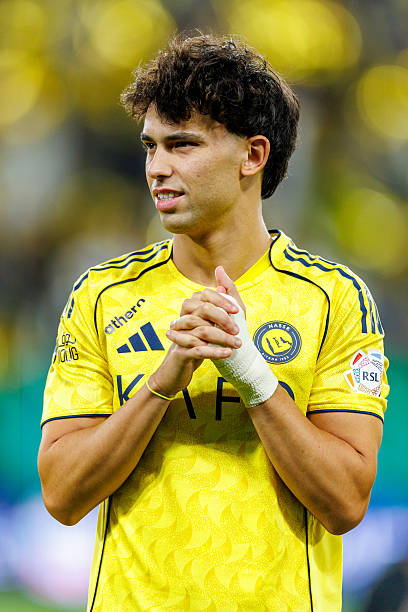
Introduction: The Wait That Made the Brace Even Sweeter
There is a particular kind of pressure that descends on elite footballers during goal droughts — not merely the external noise of media analysis and social media scepticism, but the internal dialogue that every professional striker knows: the one that runs on a loop through training sessions, replays missed chances in vivid slow motion, and turns the act of finishing, usually instinctive, into something weighted with accumulated anxiety. For Joao Felix, that dialogue had been running for an uncomfortably long time by the time Al-Nassr arrived at the Prince Mohammed bin Fahad Stadium in Dammam on Saturday, March 14, 2026.
The drought had stretched to 14 league matches — a barren run in the Saudi Pro League that stood in stark and painful contrast to the extraordinary form he had shown in the first half of the season, when hat-tricks, Man of the Match awards, and a leading role in one of the most exciting attacking units in world football had made him look like the player the world had always believed he could be.
Since ending with a goal in the 2-2 draw against Al-Ettifaq in December 2025, league goals had stubbornly refused to come, even as he contributed seven assists across his previous ten appearances and collected multiple Man of the Match awards for performances that, on any objective assessment, had been more than acceptable.
And then, against Al-Khaleej, in the second half of a match that Al-Nassr were controlling without quite finishing off, Joao Felix reminded everyone — himself included — exactly what he is capable of. Two goals in six minutes. A brace that ended the Joao Felix Al-Nassr goal drought at a stroke and, in combination with goals from Abdullah Al-Hamddan, Aiman Yahya, and Brazilian youngster Angelo Gabriel, contributed to a 5-0 rout that sent the Knights of Najd three points clear at the top of the Saudi Pro League table.
The timing was perfect. Cristiano Ronaldo — sidelined for a second consecutive match with the hamstring injury he had sustained the previous week — was watching from home rather than standing alongside his Portuguese compatriot at the stadium. In his absence, Felix stepped into the void and delivered. And in the post-match press conference, he explained, with the kind of mature, unflappable calm that has become one of the most striking features of his Al-Nassr persona, exactly how he had handled the drought.
“This comes with maturity,” Felix said, as reported by the official Saudi Pro League website. “I’m not new in the game, so I know how I need to deal with those kinds of things. If I’m not scoring, it’s OK. It happens. But sometimes I will shoot bad and it goes in, and sometimes I shoot good and it doesn’t go in. So I just need to be calm, just to stay relaxed, because the goals will appear when I need.”
Those words — calm, relaxed, goals will appear when I need — capture something essential about where Joao Felix is in his career and in his life. This is not the anxious, heavy-burdened footballer who left Atlético Madrid under a cloud, who struggled at Chelsea and Barcelona to translate his undeniable talent into consistent performance. This is a man who has found his environment, his confidence, and his equilibrium — and who has the maturity to manage the inevitable rough patches of a long season without allowing them to spiral into a crisis.
1. The Match: Al-Nassr 5-0 Al-Khaleej — Felix Takes Centre Stage
A Slow Start, a Brilliant Finish
The game itself was not a straightforward procession. Al-Nassr, without both Ronaldo and Sadio Mané, were expected to dominate Al-Khaleej — a side that sits outside the top half of the Saudi Pro League table and posed limited theoretical threat to the league leaders. But football theory and football reality do not always correspond, and the opening half-hour in Dammam was tighter than the eventual scoreline suggests.
Abdullah Al-Hamddan, the mid-season acquisition whose goals in Ronaldo’s absence have been invaluable, opened the scoring in the 31st minute — capitalising on a defensive error by Al-Khaleej to fire a low shot past keeper Anthony Moris. The goal was the product of patient build-up play rather than any particularly inspired individual moment, but it established the platform from which the match’s second half would unfold in devastating fashion.
The second goal arrived nine minutes after the interval, when Aiman Yahya struck powerfully from inside the box to double Al-Nassr’s advantage. His finish — a study in composure under pressure, placing the ball low and hard beyond Moris — brought a roar from the travelling Al-Nassr support and provided the context for what was to follow: a final half-hour in which Felix, liberated by the scoreline and the opportunity it created, delivered the kind of performance that had been the hallmark of his first half of the season.
Felix’s First Goal: “He Both Began and Finished a Well-Worked Move”
The Joao Felix Al-Nassr goal drought officially ended in the 73rd minute, and in a manner that was elegantly characteristic of his best work. Rather than a tap-in or a scrambled finish of the type that sometimes ends barren runs for forwards too desperate to make contact with anything in the vicinity of the goal, Felix’s first of the evening was a well-crafted team goal in which he was both the initiator and the finisher — a detail that speaks to the completeness of his contribution even during the goalless period.
The official Saudi Pro League match report noted that Felix began and finished a well-worked move for his first goal, tucking away Al-Hamddan’s cross from close range to make it 3-0 in the 73rd minute. The combination of his movement to create the space, his timing to arrive at the delivery, and his precision to finish from close range without the panicked rush that so often afflicts forwards coming off goal droughts reflected exactly the mental state he had described in training — calm, relaxed, letting the moment arrive rather than forcing it.
Felix’s Second Goal: Clinching the Statement
Six minutes after the first, the Joao Felix Al-Nassr goal drought was made even more emphatically a memory when he added his second, profiting from good work by Angelo Gabriel to fire past Moris and complete a 4-0 scoreline that effectively ended any remaining resistance from the hosts. The second goal differed from the first in its nature — more direct, capitalising on a quick transition and the space opened up by Gabriel’s driving run — and illustrated the different dimensions of Felix’s attacking repertoire that Jorge Jesus has been deploying across the season.
Angelo Gabriel then added a fifth in stoppage time to complete the rout, with Felix providing the assist — his 11th of the campaign — to finish the evening with a goal, a goal, and an assist in the second half alone. By any measure, it was a complete performance from a player who had been under pressure to demonstrate his worth in Ronaldo’s absence, and who responded in the most convincing possible fashion.
The post-match statistics told a comprehensive story: Felix ended the match with his eighth Man of the Match award of the season, moved to 15 Saudi Pro League goals for the campaign, and sits joint-top of the assist charts with 11 — figures that, even during the 14-game league goal drought, had not diminished his standing as one of the most influential players in the Saudi Pro League.
2. The Drought in Context: Joao Felix Al-Nassr Goal Drought Explained
Not a Crisis — A Blip in a Sensational Season
The framing of the Joao Felix Al-Nassr goal drought as a crisis — the narrative that some sections of social media and certain commentators had constructed around his 14-match league barren run — was, even before the Al-Khaleej brace, demonstrably unfair. While a striker going 14 league games without scoring is a legitimate area of interest, the specific circumstances of Felix’s drought merit careful examination rather than knee-jerk assessment.
Most significantly, the period of the Joao Felix Al-Nassr goal drought coincided almost exactly with the injury problems and absences that disrupted Al-Nassr’s collective attacking rhythm in the second half of the season. Sadio Mané’s extended absence — initially at the Africa Cup of Nations with Senegal and subsequently due to injury — removed one of the key creative and defensive pressure-releasing elements of Al-Nassr’s system. Without Mané’s tireless pressing and incisive running from wide positions, opposing defences found it marginally easier to concentrate their attention on Felix and on suppressing the central attacking threat.
Additionally, Ronaldo’s own fitness issues — he missed games through a hamstring complaint — periodically removed the defensive attention that Ronaldo naturally draws, leaving Felix as the primary defensive focal point for opponents. Without Ronaldo’s gravitational pull on opposition backlines, the spaces that Felix had been exploiting so devastatingly in the first half of the season became fractionally harder to access.
Seven Assists in Ten Games: Contribution Never Stopped
The statistic that most effectively contextualises the Joao Felix Al-Nassr goal drought is the seven assists he accumulated across his previous ten appearances without scoring. Forwards who are truly struggling — who have lost their confidence, their sharpness, or their connection with the team — do not record that kind of creative output. A player contributing an assist every 1.4 games is performing at a high level; the absence of goals in that period reflects the randomness of finishing rather than any meaningful decline in quality or application.
The Saudi Pro League’s own coverage — which included multiple Man of the Match awards for Felix during the barren run — confirmed this reading. His performances at Al-Kholood and Al-Fayha were notable for their control, their creativity, and their leadership in the absence of Ronaldo. The Joao Felix Al-Nassr goal drought was, in the truest sense, a statistical anomaly rather than a reflection of genuine underperformance.
Felix himself articulated this distinction with notable clarity. His observation that “sometimes I will shoot bad and it goes in, and sometimes I shoot good and it doesn’t go in” is not an excuse — it is an accurate description of the variance that characterises elite attacking play. The footballer who claims there is no element of fortune in goal-scoring is either naive or dishonest. Felix’s maturity lies in acknowledging that randomness, accepting it without anxiety, and continuing to do the work that eventually produces the outcomes.
3. Without Cristiano Ronaldo: Felix Steps Into the Void
A Second Consecutive Absence for the Captain
Cristiano Ronaldo missed the Al-Khaleej match for the second consecutive Saturday, having sustained a hamstring injury that also kept him out of the previous week’s 1-0 win over Neom SC. The nature of hamstring injuries — prone to aggravation if returned from too quickly, potentially season-disrupting if mismanaged — made Ronaldo’s caution entirely understandable, even if his absence from such a crucial period of the title race was a source of genuine concern.
Al-Nassr under Jorge Jesus have, throughout the season, been most effective when all four of their attacking quartet — Ronaldo, Felix, Mané, and Kingsley Coman — are available simultaneously. As Felix himself had noted in his landmark interview with the Saudi Pro League website: “I think that, when all four of us are doing well, we’re unstoppable here in Saudi Arabia.” The corollary, however, is that the absence of any one of those four requires the others to adjust and compensate — and the manner in which Al-Nassr have navigated Ronaldo’s two-game absence suggests a squad depth and collective resilience that Ronaldo’s all-consuming presence had previously obscured.
Two games without Ronaldo. Two wins. Two clean sheets. A 1-0 win over Neom, then a 5-0 demolition of Al-Khaleej. The statistics invite a conclusion that some Al-Nassr fans were not shy about drawing on social media: that the team is capable of extraordinary performances without their captain and that the tactical dependency on Ronaldo’s specific qualities — his physical presence in the box, his penalty-taking, his ability to attract defenders — may have been limiting Felix and others in subtle ways throughout the season.
Jorge Jesus’s Rotation and Felix’s Leadership
Jorge Jesus, who came to Al-Nassr in the summer after masterminding Al-Hilal’s record-setting 2023-24 season, made a pointed tactical statement by trusting Felix as the primary attacking outlet in Ronaldo’s absence. Rather than simply asking Felix to fill Ronaldo’s specific role — a physically and tactically different assignment from his natural attacking midfielder/second striker position — Jesus gave him the freedom to roam and to lead the line in his own style.
The result was a performance that demonstrated Felix’s full technical range: his ability to press high and create turnovers, his incisive movement between the lines, his link-up play with Angelo Gabriel and Coman, and — ultimately — his clinical finishing when the opportunities arrived. The drought ended not because the situation changed but because Felix remained patient enough to allow his natural quality to reassert itself in the conditions Jesus had created for him.
The fans who argued on social media that Al-Nassr are better without Ronaldo were, of course, engaging in the selective reading that two results invite. Ronaldo’s overall contribution to the season — his goals, his penalties, his leadership in training and in the dressing room — remains fundamental to Al-Nassr’s title challenge. But the capacity of the team to perform at this level in his absence is a genuine source of confidence as the title race enters its decisive final eight matchweeks.
4. Joao Felix at Al-Nassr: The Redemption Story of the Season
From Jorge Jesus’s Public Warning to Saudi Pro League Sensation
The story of Joao Felix at Al-Nassr is, by any reasonable standard, one of the most remarkable individual turnaround narratives in world football in 2025–26. The player who arrived at the Riyadh club on July 29, 2025, having signed for an initial fee of £26.2 million from Chelsea, was not universally celebrated. His debut against Toulouse was, by his own admission, underwhelming — and manager Jorge Jesus was direct in his assessment, warning publicly that Felix would need to “prepare better” if he was to return to his peak form.
That public warning, delivered in the blunt manner that has characterised Jesus’s management throughout his career, could have been devastating for a player whose confidence had already been tested by difficult spells at Atlético Madrid, Barcelona, AC Milan, and Chelsea. Instead, it appears to have galvanised a response. By matchweek 5 of the Saudi Pro League, Felix had scored a hat-trick against Al-Taawoun in a 5-0 win — followed by another treble later in the season that announced him as the most dynamic attacking force in the division.
By the time of the Al-Khaleej brace, Felix had accumulated 15 Saudi Pro League goals in the season — a figure that, in the context of his career history, represents a remarkable personal benchmark. The man who had struggled to score 14 Premier League goals in 62 appearances for Manchester United in previous seasons, who had never reached 20 league goals in a campaign at any of his European clubs, was delivering at a consistency that, before this season, even his most ardent supporters would not have predicted with confidence.
The Comparison With His European Career: Context and Vindication
The specific comparison between Felix’s current Al-Nassr form and his European career is worth examining with care, because it carries implications both for how we assess the Saudi Pro League as a competition and for what it tells us about the specific environments in which Felix has historically thrived and struggled.
At Atlético Madrid, Felix signed for a record €126 million in 2019 — a fee that placed him among the most expensive footballers in the world and created a burden of expectation that his first few seasons at the club were inadequate to bear. Diego Simeone’s system — disciplined, defensive, and based on counter-attacking football that placed enormous defensive demands on its forwards — was, by widespread consensus, a poor fit for a player whose primary instincts are creative and attacking rather than defensive and positional. Felix won the La Liga title in his third Atlético season, but the sense of a player constrained rather than liberated persisted throughout his time in Madrid.
At Chelsea, under multiple managers across two separate spells, Felix occasionally produced the flashes of brilliance that had made him the most expensive teenager in football history, but consistency was elusive. His loan spell in Barcelona brought arguably his best European form — he was genuinely excellent for moments under Xavi — but the permanent return to Chelsea did not sustain it. The pattern was of a player whose talent was visible but whose environment was never quite right.
At Al-Nassr, under Jesus’s structured but freedom-permitting system, alongside players of the quality and experience of Ronaldo, Mané, and Coman, Felix has found the combination of demands and liberties that suits him best. The coaching is demanding but clear. The teammates are world-class but cooperative rather than ego-driven in their internal dynamic. And the physical environment — Saudi Arabia’s climate, its stadiums, its football culture — has evidently agreed with him in ways that London and Madrid never quite did.
5. Felix’s Own Words: The Philosophy That Ended the Joao Felix Al-Nassr Goal Drought
“I Just Need to Be Calm”
The post-match press conference at Al-Khaleej produced the most direct and revealing insight into Felix’s mindset during the Joao Felix Al-Nassr goal drought — and, by extension, into the mental framework he has developed across a career that has encompassed extraordinary highs and genuine lows. His words deserve to be quoted and examined at length, because they reflect a maturity that has clearly been earned rather than simply claimed.
“This comes with maturity,” Felix said. “I’m not new in the game, so I know how I need to deal with those kinds of things. If I’m not scoring, it’s OK. It happens. But sometimes I will shoot bad and it goes in, and sometimes I shoot good and it doesn’t go in. So I just need to be calm, just to stay relaxed, because the goals will appear when I need.”
The phrase “when I need” is worth dwelling on. It suggests not merely patience but confidence — the certainty that when the moment of greatest need arrives, the capacity to deliver will be there. This is the psychological foundation of elite performance under pressure, and it is a quality that Felix, for much of his career, appeared to struggle to access consistently. The player who was sometimes criticised at Atlético for disappearing in big moments, who occasionally looked overwhelmed by the weight of his own transfer fee, has evolved into someone who genuinely believes in his own capacity to step up when the team requires it. The Al-Khaleej brace was the most recent proof of that belief.
“Just Enjoy Football”
Earlier in the season, in his first extended interview with the Saudi Pro League, Felix articulated a broader philosophy that provides the context for understanding how he managed this barren run with such evident composure. “Just enjoy football as much as you can, enjoy what football brings you, because all this goes by very quickly,” he told reporters.
That statement — simple on its surface, profound in its implications — reflects a player who has genuinely internalised the lessons of a career that contained more disappointment than a talent of his magnitude should have had to endure. The experiences of leaving Benfica at 19 for a record fee, of being publicly questioned at Atlético, of the loan exits, of the difficult Chelsea spells — all of those chapters, processed and absorbed, have produced a man who approaches his sport with enjoyment rather than obligation.
The same philosophy explains his famous observation about goals and assists: “I never plan to score ‘X’ goals, or [get] ‘X’ assists. The project is always to try to win as many titles as we can. The goals and assists come as a consequence of my work, of the team’s work.” For a player in the middle of a 14-game league drought, this is not a platitude — it is a genuinely operational mindset that prevented the drought from becoming a crisis of confidence.
6. The Title Race: What Felix’s Brace Means for Al-Nassr’s Ambitions
Three Points Clear at the Summit
The 5-0 victory over Al-Khaleej, powered by Felix’s brace, came on the same evening that rivals Al-Ahli were beaten at Al-Fayha in dramatic fashion — a result that opened the standings further in Al-Nassr’s favour. At the end of matchweek 26, Al-Nassr sit at the top of the Saudi Pro League on 67 points, three clear of Al-Hilal on 64 and five ahead of third-placed Al-Ahli. Al-Qadsiah, who had briefly threatened to disrupt the top two with a dramatic 3-2 comeback win over Al-Ahli on Friday, sit seven points adrift in fourth.
With eight matchweeks remaining and the Saudi Pro League entering a 20-day international break before action resumes on April 3 for matchday 27, the title is firmly in Al-Nassr’s hands. Felix’s own assessment was direct and confident: “Yeah, of course we know the results [of our title rivals]. Yesterday we saw the [Al-Qadsiah versus Al-Ahli] game. Today, I don’t know the Al-Hilal score yet, but we are first. If we do our job, we will win the league. We just depend on ourselves. And that’s our focus.”
The phrase “we just depend on ourselves” is the cleanest possible articulation of what a team in Al-Nassr’s position should be saying and thinking. They do not need to watch rivals. They do not need to manage other results. They lead the table, they have the best squad, and they have just demonstrated — with Ronaldo absent and the Joao Felix Al-Nassr goal drought finally ended — that they possess the depth and quality to produce ruthless performances when the title demands it.
Thirteen Consecutive League Victories: A Championship Run
Al-Nassr’s title credentials are further underlined by the extraordinary consistency of their recent record. The 5-0 win over Al-Khaleej extended their consecutive league victory run to thirteen — a streak that encompasses the full range of opponents from near-equals to outclassed minnows and that demonstrates the consistency of application that distinguishes potential champions from merely talented squads.
The Arab News characterised the performance as a statement: “Al-Nassr made a clear statement against Al-Khaleej: their strength lies in the collective, not in individual stars. Thirteen consecutive league victories now underline that point.” That observation — collective strength rather than individual brilliance — is particularly resonant in the context of the Joao Felix Al-Nassr goal drought, which ended not through any individual fix but through the patient continuation of collective work.
7. Ronaldo and Felix: The Portuguese Partnership at Al-Nassr
“He Ends Up Helping” — The Relationship That Defined the Season
The relationship between Joao Felix and Cristiano Ronaldo at Al-Nassr has been one of the most discussed dynamics in world football since Felix’s arrival in the summer of 2025. The prospect of two Portuguese international stars — from different generations, with contrasting playing styles, each carrying the weight of significant expectation — operating in the same attacking line was either a recipe for extraordinary success or an irreconcilable clash of egos. Reality has emphatically delivered the former.
In his early interview with the Saudi Pro League, Felix was characteristically generous and specific about the value Ronaldo brings beyond goals and assists. “Of course, having Cristiano as a teammate is always good, for everything he brings to the team, all the teachings.” And in a separate Goal.com interview, he expanded on how Ronaldo’s presence specifically benefits him: “He ends up helping” — because defenders focus on Ronaldo, space opens up for Felix to operate in.
The truth of that observation was apparent throughout the first half of the season, when Felix was scoring with remarkable frequency in the gaps created by the defensive attention Ronaldo attracted. The Joao Felix Al-Nassr goal drought coincided, partially, with periods when Ronaldo was either absent or not in full form — and with the consequent defensive reorientation that removed some of the architectural advantages Felix had been exploiting.
Ronaldo’s Defence of Felix’s Al-Nassr Move
One of the most remarkable aspects of the Felix-Ronaldo relationship has been Ronaldo’s public, vigorous defence of his compatriot’s decision to join Al-Nassr rather than returning to Benfica — the romantic option that many Portuguese football fans had hoped Felix would choose. “I already said it and I have no problem repeating it: I sincerely believe it was a better option for Felix to go to Saudi Arabia than to play in the Portuguese league,” Ronaldo stated at the time, in language that was blunt to the point of controversy.
With 15 Saudi Pro League goals in his debut season, the Joao Felix Al-Nassr goal drought long since ended, and a Man of the Match award collection that makes him one of the most decorated players in the competition, Ronaldo’s assessment looks prescient rather than provocative. Felix has found in Saudi Arabia not merely a football environment that suits him, but a life environment — warm, supportive, free from the European media scrutiny that had dogged his career — that allows him to perform with the enjoyment he has spoken about so consistently.
8. Felix’s Statistics: The Numbers Behind the Narrative
A Season for the Ages at Al-Nassr
The raw statistics of Joao Felix’s debut Saudi Pro League season — even accounting for the goal drought — present a picture of an elite attacking player performing at or near the top of his considerable powers. His 15 Saudi Pro League goals place him among the top scorers in the division. His 11 assists are joint-top of the assist charts. His 16 total goal involvements through the first 16 matches of the season represented, by Saudi Pro League records, one of the most prolific starts to a campaign by any player in the division’s recent history.
The Man of the Match awards — eight in total across the Saudi Pro League campaign — are perhaps the most revealing individual indicator of his influence. Man of the Match awards are distributed by observers who assess the overall impact of a player on the game, not merely their goal contribution, and the fact that Felix has accumulated eight such awards during a season that included a 14-game league goal drought speaks to the breadth and consistency of his contribution. He was being recognised as the best player on the pitch in multiple matches even when the goals were not coming.
His overall assist contribution — joint-top of the division — places him in the company of players like Kingsley Coman and the various creative midfielders who lead the Saudi Pro League’s assist charts. A forward who ranks among the division’s top two assisters is a player operating as a genuine creative engine, not merely a goal-hungry striker dependent on chance creation by others.
World Cup Implications: Demonstrating Form at the Right Moment
With the 2026 World Cup approaching in the summer, the timing of the Joao Felix Al-Nassr goal drought’s end carries implications beyond the Saudi Pro League title race. Felix, who has been a regular starter for Portugal in Roberto Martínez’s squad across major tournaments — Euro 2020, the 2022 World Cup, Euro 2024, and the 2025 UEFA Nations League triumph — will be among the first names on the team sheet for the North America tournament. His form at club level through the spring of 2026 will define both his physical condition for the tournament and the confidence with which he approaches it.
Scoring a brace against Al-Khaleej with eight matchweeks remaining in the Saudi Pro League season — and doing so in the manner he described, with composure and relaxation rather than relief and desperation — is the ideal platform for the World Cup preparations that will follow the league season’s conclusion.
9. Jorge Jesus: The Manager Who Helped End the Joao Felix Al-Nassr Goal Drought
From Warning to Winning
The arc of Jorge Jesus’s management of Felix over the 2025-26 season is one of the more instructive coaching stories of the year. The public “prepare better” warning after Felix’s debut was not a dismissal — it was a challenge, delivered by a manager who has consistently demonstrated the ability to identify what motivates individual players and to deploy that knowledge strategically.
Jesus knew what Felix needed. He needed to understand that Jorge Jesus’s Al-Nassr demanded standards — that talent alone was not a sufficient qualification for a starting place in a squad of this quality. The initial public challenge was followed by consistent support and consistent selection, a combination that allowed Felix the security to take risks while understanding the consequences of complacency.
The Joao Felix Al-Nassr goal drought — while externally discussed as a potential crisis — appears to have been managed internally with exactly the kind of equanimity that Jesus’s coaching approach encourages. Felix kept playing. Jesus kept selecting him. The Man of the Match awards kept coming. And eventually, on a Saturday evening in Dammam, the brace arrived and the drought was done.
The Collective System: Four Stars, One Team
Jesus has spoken throughout the season about his belief in the collective — the idea that Al-Nassr’s strength lies not in the sum of their individual star power but in the integration of that star power into a coherent system with defined roles, pressing patterns, and tactical structures. His comment, through Al-Nassr’s communications, that the team’s strength “lies in the collective, not in individual stars” is the most direct expression of this philosophy.
For Felix, operating within that collective — accepting the moments when the goals do not come, trusting the process, contributing through assists and pressing and chance creation — has required precisely the maturity he cited after the Al-Khaleej brace. The player and the manager are philosophically aligned, and the results of that alignment are written in the thirteen consecutive league victories, the title lead, and the individual moment when the Joao Felix Al-Nassr goal drought finally, emphatically ended.
Conclusion: The Goals That Told the Real Story
When Joao Felix tucked home Al-Hamddan’s cross in the 73rd minute against Al-Khaleej — becoming for a brief moment the most talked-about footballer in Saudi Arabia, Europe, and the wider football world — he did more than end a statistical anomaly. He confirmed, for anyone who still had doubt, that the Joao Felix who signed for Al-Nassr on July 29, 2025, has become something the many earlier versions of himself never quite managed to be: a reliable, mature, psychologically robust match-winner capable of leading the line in the absence of the world’s most famous footballer and delivering when it matters most.
The Joao Felix Al-Nassr goal drought is over. The brace is banked. The Man of the Match award is secured. The title race is entered from a position of strength. And the man who explained, with characteristic serenity, that he simply stayed calm and waited for the goals to appear when needed, is now the man at the centre of the most compelling Saudi Pro League title race in years.
Three points clear. Eight games remaining. Ronaldo recovering. Mané due back from injury. A Portuguese star who has found his home, his form, and his philosophy — and who is now, unambiguously, one of the most important players in the world’s most watched emerging football league.
“We are well; we are on the right track,” Felix said after the final whistle. Rarely in football have those words sounded more deserved.
10. The Broader Al-Nassr Picture: A Club on the Cusp of History
Seven Years Without the League Title
One dimension of the Joao Felix Al-Nassr goal drought story that provides essential context for understanding its significance is the institutional hunger that surrounds Al-Nassr’s 2025–26 title challenge. The club’s last Saudi Pro League triumph came seven years ago — the longest title drought in their modern history — and the entire project built around Ronaldo, Jesus, Mané, Felix, Coman, and the rest of the star-studded squad is defined by the desire to end that wait. Felix, who described his priority in the most direct terms — “I just want to have the league title — that’s the most important” — understands the stakes completely.
The context of the title drought creates a specific kind of pressure that a goal drought can, in a less-managed dressing room, transform into collective anxiety. That Al-Nassr have maintained their form and their mental clarity — winning thirteen consecutive league games, dealing with injuries to Ronaldo and Mané, navigating the Joao Felix Al-Nassr goal drought without any visible drop in collective confidence — speaks to the culture that Jorge Jesus has constructed and the leadership that both Ronaldo and Felix provide.
Ronaldo, despite his own periods of mixed form and injury, has been an energising rather than a destabilising force in the dressing room. His standards — in training, in preparation, in the demands he places on himself and those around him — have been absorbed by a squad that now carries expectations that were barely credible when the season began. Felix, as the squad’s second Portuguese international and one of its two most important offensive contributors, has been a crucial part of that culture.
The Return of Sadio Mané: Completing the Fearsome Four
One of the storylines that will define Al-Nassr’s final eight matchweeks is the anticipated return of Sadio Mané from the hamstring injury that has kept him sidelined for much of the second half of the season. Mané’s celebration in the Al-Khaleej post-match photographs — visible despite his inability to play — captures the communal spirit of a squad that has maintained its collective identity even through the absences of its most important players.
When Felix described the fearsome four — himself, Mané, Coman, and Ronaldo — as “unstoppable” when all four are performing well, he was drawing on evidence from the first half of the season, when all four were consistently available and Al-Nassr recorded the remarkable nine-game winning run that launched their title campaign. The prospect of reassembling that quartet for the final stretch of the season — with the Joao Felix Al-Nassr goal drought resolved, Ronaldo recovering, and Mané potentially fit by the April restart — is the scenario that should concern Al-Hilal and Al-Ahli most.
Al-Hilal: The Rivals Who Refuse to Disappear
Al-Nassr’s three-point lead over Al-Hilal — who won their own away match at Al-Fateh on the same matchday, thanks to a late Mohamed Simakan winner that came after a chaotic final sequence including a disputed penalty referral — is comfortable but not decisive. Al-Hilal, currently managed and organised with the discipline that has made them the most successful Saudi club in recent history, will not surrender without a fight.
The Simakan winner at Al-Fateh came after a dramatic sequence that tested Al-Hilal’s nerve to the limit — including a Yassine Bounou save that preserved the lead and a VAR reversal of a stoppage-time penalty that had briefly appeared to equalise. Al-Hilal’s ability to win ugly, to secure results when not playing at their best, is the hallmark of championship-calibre teams. Al-Nassr will need to maintain their current level — thirteen consecutive league wins is a phenomenal baseline — to ensure that three points becomes more than a single-game buffer.
11. The Chelsea Legacy: How Joao Felix’s European Journey Made Him the Player He Is Today
The Education of a £126 Million Teenager
The full appreciation of what Joao Felix has achieved at Al-Nassr requires understanding where he came from and what the journey to Saudi Arabia cost him in terms of reputation, confidence, and the simple pleasure of playing football without the weight of impossible expectations. The record €126 million fee that Atlético Madrid paid Benfica for a 19-year-old in the summer of 2019 was not merely a financial transaction — it was the imposition of a narrative that the teenager had no reasonable prospect of immediately fulfilling.
Diego Simeone’s Atlético was, as has been widely observed, a poor fit for Felix’s specific qualities. The tactical discipline, the defensive running, the counter-attack-first mentality — all of these demanded attributes from Felix that were secondary to his primary gifts of creativity, intelligence, and technical brilliance. He could produce those attributes under Simeone, and occasionally did with devastating effect, but the system extracted maximum effort for below-maximum return in a way that gradually eroded both his confidence and the public perception of his talent.
The loan spells — Barcelona, Chelsea — produced flashes of the player that the fee had promised, without the sustained environment to make those flashes permanent. His periods under Xavi at Barcelona were genuinely impressive; the tactical freedom afforded by a possession-based, technically demanding system suited him naturally. But the return to Chelsea — first on loan, then permanently — did not replicate those conditions, and his Chelsea career ended with the sale to Al-Nassr that many in European football interpreted as a retreat.
It Was Not a Retreat: It Was a Decision
The narrative of retreat — of a gifted player accepting that his European adventure was over and retreating to a less demanding environment — was always an oversimplification, and the 2025–26 season has made it look actively misleading. What Felix did in moving to Al-Nassr was not retreat but recalibration: a deliberate choice to prioritise environment, enjoyment, and the specific conditions for success over the prestige of a European address.
The Saudi Pro League in 2025–26 is not the same competition it was five years ago. The arrival of players of the calibre of Ronaldo, Mané, Coman, Felix himself, Iñigo Martínez, Marcelo Brozović, and dozens of other world-class names has transformed it into one of the most technically demanding and physically intense competitions outside Europe’s top five leagues. Felix was not moving away from the challenge — he was moving toward a different version of it, one better suited to his specific needs at this specific moment in his career.
The Joao Felix Al-Nassr goal drought, and the composure with which he navigated it, is the clearest possible evidence that his self-assessment was correct. This is a player who has found his level, his confidence, and his joy — and who is demonstrating those qualities on a weekly basis in a league that, whatever its residual sceptics may claim, is watched and analysed by the global football community with genuine interest.
12. Looking Ahead: Felix, the World Cup, and the Second Half of 2026
World Cup Summer: The Biggest Stage of All
Joao Felix’s 2026 will be defined not just by whether Al-Nassr win the Saudi Pro League title — though the significance of that achievement for the club, for Ronaldo, and for everyone involved in the project cannot be understated — but by the World Cup in North America, where Portugal will be among the genuine contenders for football’s ultimate prize.
Felix has been central to Roberto Martínez’s Portugal project since the 2022 World Cup, where he appeared — alongside Ronaldo, Bruno Fernandes, and Bernardo Silva — in a squad of generational quality that was ultimately eliminated in the quarter-finals by Morocco. The 2025 UEFA Nations League triumph, in which Felix contributed two goals against Armenia in the qualifying phase, has further embedded his position as one of the three or four most important players in the Portuguese attack.
His form through the spring of 2026 — the brace against Al-Khaleej, the assist statistics that place him joint-top of the Saudi Pro League charts, the eight Man of the Match awards — provides exactly the platform of confidence and physical sharpness that a World Cup campaign requires. He enters the tournament not as a player carrying doubts but as one who has resolved his longest goal drought with elegance and is now demonstrably in form.
For Portugal — whose hopes of ending their World Cup wait are bound up in the collective quality of a squad that also includes Ronaldo, Bruno Fernandes, Rafael Leão, and Vitinha — Felix represents the X-factor: the technical creativity and directness that can unlock defences organised specifically to neutralise the more predictable threats. His willingness to describe his World Cup priorities simply and directly — “I just want to have the title” in league terms translates directly to a World Cup ambition that needs no elaboration — is characteristic of a man who is focused on outcomes rather than individual milestones.
The Joao Felix Al-Nassr goal drought of 2025–26 will, by the time the World Cup comes around, be a footnote. What will matter is the form he takes into those summer matches, the confidence built by fifteen Saudi Pro League goals and eleven assists, and the philosophical maturity that allowed a temporary barren run to pass without damaging a season — or a career — that is clearly entering its finest chapter.


