
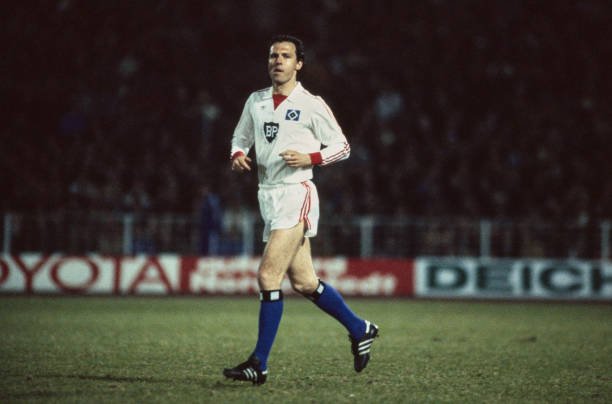
Franz Beckenbauer Biography: How “Der Kaiser” Redefined the Defender Role Forever
The Franz Beckenbauer biography is the story of football’s most complete leader—a player who reinvented how defenders touch, carry, and pass the ball, and a manager who conquered the world a second time from the touchline. Born in Munich on September 11, 1945 (Wikipedia), “Der Kaiser” won two Ballon d’Or awards (1972 and 1976), captained Bayern Munich to three straight European Cups, and became one of only three people in history to win the FIFA World Cup as both a player (1974) and a manager (1990) before passing away on January 7, 2024, at the age of 78 (Britannica; FC Bayern).
Early Life in Munich & The Slap That Changed German Football
Franz Anton Beckenbauer was born in Munich’s Maxvorstadt borough and grew up in the working-class district of Giesing (Wikipedia). As a teenager, he originally planned to join local powerhouse TSV 1860 Munich. However, during a youth match in 1958, a 1860 Munich player slapped the 13-year-old Beckenbauer—a moment of rivalry that convinced him to sign for FC Bayern Munich instead (FC Bayern).
Beckenbauer made his senior Bayern debut on June 6, 1964, playing on the left wing in a Bundesliga promotion play-off against FC St. Pauli (Wikipedia). A year later, Bayern won promotion to the Bundesliga—and German football was never the same again.
The Bayern Munich Dynasty & Inventing the Libero
Over 13 senior seasons in Munich, Beckenbauer turned Bayern from a regional club into Europe’s dominant force. Across 396 Bundesliga appearances, he scored 44 goals, winning four German league championships (1969, 1972, 1973, 1974) and four DFB Cups (1966, 1967, 1969, 1971) (FC Bayern; Franz Beckenbauer Official).
On the continental stage, he lifted the 1967 European Cup Winners’ Cup before captaining Bayern to three consecutive European Cups (1974, 1975, and 1976)—becoming the first player in history to win three European Cups as club captain (Wikipedia). Alongside his two Ballon d’Or triumphs (1972 and 1976) and four German Footballer of the Year awards, Beckenbauer transformed the sweeper (libero) from a last-ditch destroyer into a deep-lying playmaker who launched attacks from his own penalty area (Britannica; Simple Wikipedia).
New York Cosmos, Hamburger SV & NASL Stardom
In 1977, Beckenbauer shocked European football by accepting a lucrative move to the North American Soccer League (NASL) to join the New York Cosmos alongside Pelé (Wikipedia). Across two spells in New York (1977–1980 and 1983), he made 132 appearances, scored 23 goals, and won three NASL Soccer Bowl championships (1977, 1978, and 1980)—later earning induction into the U.S. National Soccer Hall of Fame (RSSSF; Wikipedia).
Between his two Cosmos stints, he returned to Germany with Hamburger SV (1980–1982), capturing a fifth career Bundesliga title in 1982 before retiring in 1983 (Wikipedia; Franz Beckenbauer Official).
West Germany: 1966 Heartbreak, 1970 Grit & 1974 World Cup Glory
Beckenbauer debuted for West Germany on September 26, 1965, against Sweden and became the first German player to surpass 100 international appearances, finishing with 103 caps and 14 goals (Wikipedia; Franz Beckenbauer Official).
At just 20 years old, he starred at the 1966 FIFA World Cup in England, reaching the final at Wembley before a 4–2 extra-time defeat (Alamy Archive). Four years later, in the 1970 semi-final against Italy—widely dubbed the “Game of the Century”—Beckenbauer suffered a broken collarbone and dislocated shoulder late in regulation with West Germany out of substitutions. Refusing to leave his teammates short-handed, he played more than 50 minutes of extra time with his arm strapped in a sling (CBC Sports; Reddit Classic Soccer).
Glory arrived soon after. Beckenbauer led West Germany to the UEFA Euro 1972 title with a 3–0 final win over the Soviet Union (Wikipedia), and in 1974 he captained his country to the FIFA World Cup on home soil—defeating Johan Cruyff’s Netherlands 2–1 in Munich to become the first captain to lift the current FIFA World Cup Trophy (Inside FIFA).
Managerial Mastery: 1990 World Cup & Bayern Munich Leadership
Rather than fading into retirement, Beckenbauer stepped straight into management with West Germany in 1984. He guided Die Mannschaft to the 1986 World Cup final—falling 3–2 to Diego Maradona’s Argentina—before returning four years later in Italy to beat Argentina 1–0 in Rome and lift the 1990 FIFA World Cup (Britannica; The Temporal Wisdom).
He later stepped in twice as Bayern Munich’s interim coach, winning the 1993–94 Bundesliga and 1996 UEFA Cup, before serving as Bayern president (1994–2009) and leading Germany’s successful bid to host the 2006 FIFA World Cup (FC Bayern). Germany later honoured his legacy by naming the national supercup the Franz Beckenbauer Supercup (SofaScore).
My Take: The Positional Analytics That Make Der Kaiser Untouchable
Everyone praises Beckenbauer’s effortless posture and outside-of-the-boot passing.
What the historical numbers reveal is how completely he broke football’s positional hierarchy. In an era dominated by prolific forwards like Gerd Müller and Johan Cruyff, Beckenbauer won two Ballon d’Ors (1972 and 1976) as a defender (Ballon d’Or; Simple Wikipedia)—still an extraordinary outlier for any centre-back or sweeper.
Across 103 international caps, he scored 14 goals (0.14 per game) from deep while anchoring a West Germany side that won Euro 1972 and the 1974 World Cup, alongside a Bayern Munich dynasty that captured three straight European Cups and four Bundesliga titles (SofaScore; Britannica). Add his 396 Bundesliga appearances (44 goals) and 132 NASL games (23 goals), and you see a defender with the creative output of a No. 10 (FC Bayern; RSSSF).
Modern football analytics celebrates ball-playing centre-backs who progress play and break lines. Beckenbauer didn’t just post those numbers—he invented the position, and then won World Cups from it as both captain and coach.
Frequently Asked Questions (FAQs)
When was Franz Beckenbauer born and when did he pass away? Franz Anton Beckenbauer was born on September 11, 1945, in Munich, Germany, and passed away on January 7, 2024, at the age of 78 (Wikipedia; FC Bayern).
How many Ballon d’Or awards did Franz Beckenbauer win? He won two Ballon d’Or awards, in 1972 and 1976, and was named German Footballer of the Year four times (Simple Wikipedia).
Did Franz Beckenbauer win the World Cup as both a player and a manager? Yes. He captained West Germany to victory at the 1974 FIFA World Cup and managed them to the 1990 FIFA World Cup title, making him one of only three people in history to achieve both (Britannica).
Why did Franz Beckenbauer play with his arm in a sling in 1970? During the 1970 World Cup semi-final against Italy, Beckenbauer suffered a broken collarbone and dislocated shoulder, and with all substitutions used, he played over 50 minutes of extra time with his arm strapped in a sling (CBC Sports).
How many caps and goals did Beckenbauer have for West Germany? He earned 103 caps and scored 14 goals for the West Germany national team between 1965 and 1977 (SofaScore; Franz Beckenbauer Official).
Data From (Sources & References)
All career milestones, managerial honours, club totals, and international stats in this biography were compiled and verified from the following official and sports-data sources:
Biography & Official Club/National Archives: FC Bayern Munich Hall of Fame (Franz Beckenbauer), Franz Beckenbauer Official Website, Inside FIFA (Tribute to Franz Beckenbauer), Encyclopaedia Britannica (Franz Beckenbauer), and Wikipedia (Franz Beckenbauer)
Career Appearances, Goals & Tournament History: RSSSF (Franz Beckenbauer Career Data), Ballon d’Or Player Profile, SofaScore (Franz Beckenbauer Stats), and CBC Sports (1970 World Cup Semi-Final)


