
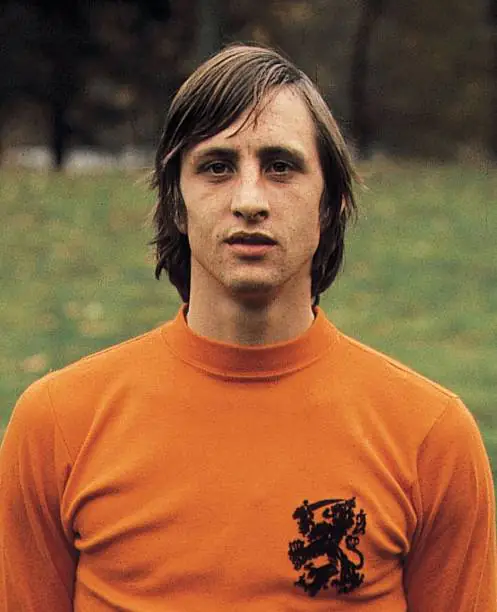
Johan Cruyff Biography: The Architect of Total Football and Modern Barcelona
The Johan Cruyff biography is the story of the man who reshaped how football is played and coached. Born Hendrik Johannes Cruijff on April 25, 1947, in Amsterdam (World of Johan Cruyff), Cruyff won three Ballon d’Or awards (1971, 1973, 1974), embodied Rinus Michels’ Total Football, and later built FC Barcelona’s “Dream Team” before passing away on March 24, 2016 (Britannica; Wikipedia).
Early Career: Ajax Dynasty, Barcelona, NASL & Feyenoord
Cruyff joined Ajax’s youth academy at age 10 and debuted at 17, spearheading a golden era from 1964 to 1973 that delivered six Eredivisie titles, four Dutch Cups, and three consecutive European Cups (1971, 1972, 1973) (Britannica).
In 1973, he transferred to FC Barcelona—captaining them to the 1974 La Liga title and scoring 86 goals in 231 appearances (FC Barcelona; Britannica). He later starred in the United States with the Los Angeles Aztecs (winning 1979 NASL MVP) and Washington Diplomats, before returning to win two more league titles with Ajax and a domestic double with rivals Feyenoord in 1983–84 (Britannica; Wikipedia).
Netherlands & The 1974 FIFA World Cup
Cruyff earned 48 caps and scored 33 goals for the Netherlands (BarcelonaYellow). At the 1974 FIFA World Cup in West Germany, his relentless movement and invention—including the iconic “Cruyff Turn” against Sweden—earned him Player of the Tournament despite a 2–1 final defeat to West Germany (SofaScore; FIFA.com).
Managerial Revolution: Ajax & Barcelona’s “Dream Team”
After retiring in 1984, Cruyff coached Ajax to the 1987 European Cup Winners’ Cup before returning to FC Barcelona (1988–1996) (Britannica). There, he won four consecutive La Liga titles, the 1989 Cup Winners’ Cup, and delivered Barcelona’s first-ever European Cup in 1992, laying the tactical blueprint that still defines the club today (FourFourTwo; World of Johan Cruyff).
My Take: The 1974 World Cup Analytics That Still Stand Untouched
Everyone remembers Cruyff as a philosopher and artist.
Yet the 1974 World Cup tracking data shows he was also a statistical machine. Cruyff created 36 chances at Germany 1974—still the all-time single-tournament World Cup record, nine ahead of Diego Maradona’s 27 in 1986 (FIFA.com). He added 34 successful dribbles (including 12 in one match vs Sweden) and 136 final-third passes (FourFourTwo; FIFA.com).
Across seven games, he averaged an 8.90 SofaScore Rating with 3 goals, 3 assists, 4.7 key passes, and 7.3 ball recoveries per match—while the Netherlands lost just one of 29 matches with Cruyff between 1970 and 1974 (SofaScore; FourFourTwo). Total Football wasn’t just pretty; Cruyff had the two-way numbers to back it up.
Frequently Asked Questions (FAQs)
When and where was Johan Cruyff born? Hendrik Johannes Cruijff was born on April 25, 1947, in Amsterdam, Netherlands, and passed away on March 24, 2016, in Barcelona (World of Johan Cruyff).
How many Ballon d’Or awards did Johan Cruyff win? Cruyff won three Ballon d’Or awards—in 1971, 1973, and 1974 (Wikipedia).
What did Johan Cruyff win as manager of FC Barcelona? Between 1988 and 1996, he won four La Liga titles, the 1989 European Cup Winners’ Cup, and Barcelona’s first-ever European Cup in 1992 (Britannica; FourFourTwo).
What World Cup record does Johan Cruyff still hold? He created 36 chances at the 1974 FIFA World Cup—the highest total by any player in a single World Cup tournament (FIFA.com).
Data From (Sources & References)
All career milestones, managerial honours, and 1974 World Cup analytics in this biography were compiled and verified from the following official and sports-data sources:
Biography & Club Legacy: Encyclopaedia Britannica (Johan Cruyff), Wikipedia (Johan Cruyff), The World of Johan Cruyff, and FC Barcelona Official Legend Card
1974 World Cup & Historical Analytics: FIFA.com (Cruyff’s 36 Chances Created), SofaScore (1974 World Cup Team of the Tournament), and FourFourTwo (Cruyff by the Numbers)


