
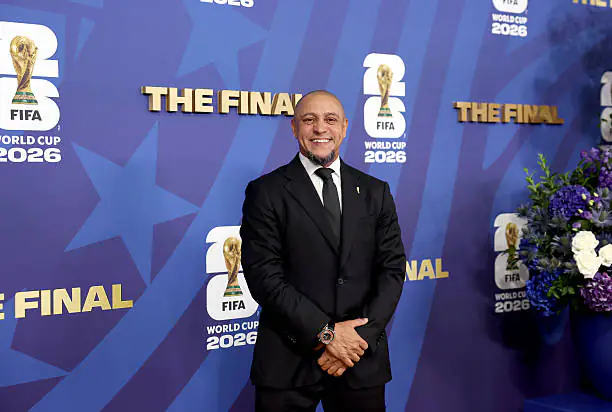
Roberto Carlos Biography: How a Left-Back Redefined Attacking Football
Few defenders in football history have altered the geometry of the pitch quite like Roberto Carlos da Silva. Born on 10 April 1973 in Brazil, the former left-back and football coach transformed a traditionally conservative position into one of the most dangerous attacking outlets in world football (Simple Wikipedia; Real Madrid Legends). Blending sprinter-level acceleration, relentless stamina, and a left foot capable of generating extraordinary velocity, he became a cornerstone of both Real Madrid‘s Galácticos era and Brazil’s golden international generation (Real Madrid Legends; Wikipedia).
This Roberto Carlos biography traces his journey from his early teenage ambitions in Brazil to 527 official appearances at the Santiago Bernabéu, a World Cup triumph in 2002, and a managerial career spanning Turkey, Russia, and India (Real Madrid Legends; Wikipedia).
Early Career in Brazil: União São João, Atlético Mineiro, and Palmeiras
Roberto Carlos first began dreaming of a professional football career in 1986, and his rise through the domestic ranks in Brazil was rapid (Real Madrid Legends). He broke into senior football with União São João during the 1991–92 period, where his explosive pace and attacking instincts earned widespread acclaim across Brazil by the age of 19 in 1992 (Real Madrid Legends).
Following a brief loan spell at Atlético Mineiro between 1992 and 1993—where he made 3 league appearances without scoring—his career accelerated dramatically upon joining Palmeiras (Wikipedia). Between 1993 and 1995, Roberto Carlos played 44 league matches and scored 3 goals for Palmeiras (Wikipedia). More importantly, he formed a celebrated left-wing partnership with fellow Brazilian star Rivaldo, helping Palmeiras capture two Brazilian league titles and establishing himself as one of South America’s premier young talents (Real Madrid Legends).
Moving to Europe: One Season at Inter Milan (1995–1996)
Roberto Carlos’s performances in Brazil earned him a move to Italy’s Serie A in 1995 when he signed for Inter Milan (Wikipedia). Although his stay in Milan lasted just a single season (1995–1996), he made an immediate impression in one of Europe’s most tactically demanding leagues, recording 30 Serie A appearances and 5 goals (Wikipedia). His ability to overlap at full speed and threaten goalkeepers from distance quickly caught the attention of Spain’s biggest club.
The Real Madrid Era (1996–2007): 11 Seasons of Dominance
In 1996, Roberto Carlos joined Real Madrid, beginning an 11-season spell that would define his legacy and cement his status among the club’s all-time greats (Real Madrid Legends). Over more than a decade in Madrid, he made 527 official appearances, with Real Madrid’s official records crediting him with 68 goals and broader career statistical archives listing 69 goals and 117 assists across those 527 matches (Real Madrid Legends; YouTube Stats Archive).
His consistency in Spain’s top flight was remarkable. In La Liga, Roberto Carlos racked up 370 appearances, 47 goals, and 100 clean sheets (Wikipedia; StatMuse). Year after year, he shouldered massive workloads on the left flank, logging peak La Liga campaign totals of 3,137 minutes, 3,143 minutes, 3,131 minutes, and 2,729 minutes (StatMuse).
The silverware matched his durability. During his 11 years in the Spanish capital, Roberto Carlos won more than 10 major titles, highlighted by three UEFA Champions League (European Cup) trophies and four La Liga championships (Real Madrid Legends; Wikipedia). Even his departure had a storybook finish: his final goal for Real Madrid came as a dramatic stoppage-time winner during the club’s 2006–07 La Liga title run (Real Madrid Legends; Wikipedia).
Later Club Career and Transition to Coaching
After leaving Real Madrid in 2007, Roberto Carlos continued playing at a high level across multiple continents. He spent two seasons in Turkey with Fenerbahçe (2007–2009), where he made 65 league appearances and scored 6 goals (Wikipedia). From there, he returned home to Brazil to represent Corinthians, moved to Russia with Anzhi Makhachkala, and later played in India for Delhi Dynamos (Wikipedia). Across all clubs in his senior playing career, statistical archives record 820 appearances, 103 goals, 157 assists, and 71,198 minutes played (YouTube Stats Archive).
Following his playing days, Roberto Carlos transitioned into football management. His coaching career included spells in charge of Anzhi Makhachkala, Turkish Süper Lig sides Sivasspor and Akhisarspor (where he was appointed in January 2015), and Delhi Dynamos in the Indian Super League (Wikipedia).
Brazil National Team & The Iconic 1997 Free Kick
On the international stage, Roberto Carlos was an indispensable fixture for Brazil for over a decade. He earned 125 official international caps and scored 11 goals for the Seleção, with Real Madrid’s legend profile noting 128 appearances in total (Wikipedia; Real Madrid Legends). He represented Brazil at three FIFA World Cups—finishing as runner-up in 1998, lifting the trophy in 2002, and competing again in 2006—alongside four Copa América tournaments, the 1997 FIFA Confederations Cup, and the 1996 Olympic Games (Wikipedia).
Yet one single moment outside the World Cup remains his most replayed highlight. On June 3, 1997, in the opening match of Le Tournoi de France against France, Roberto Carlos struck a 40-yard free kick with the outside of his left boot that bent sharply around the defensive wall and curved back inside the post, leaving the goalkeeper rooted (Wikipedia; Sky Sports; Pitch). Nearly three decades later, that strike remains one of the most studied set-pieces in football history.
My Take
Most biographies remember Roberto Carlos for highlight-reel free kicks, but the underlying physical and output metrics reveal why he was a true statistical anomaly. Real Madrid’s official profile notes that he could run 100 metres in 10.9 seconds and unleash shots reaching 140 km/h (Real Madrid Legends)—numbers closer to an elite track sprinter than a traditional full-back.
What separates him from modern attacking wing-backs is the sheer volume of his end product over 71,198 club minutes: 103 goals and 157 assists across 820 club appearances, equating to 260 direct goal involvements from a defensive starting position (YouTube Stats Archive). At the same time, he never sacrificed defensive structure in Spain, pairing 47 La Liga goals with 100 La Liga clean sheets across 370 league matches (StatMuse). He didn’t just attack from left-back; he delivered winger-level production while anchoring one of Europe’s sharpest backlines.
Frequently Asked Questions (FAQs)
How many appearances and goals did Roberto Carlos have for Real Madrid? Roberto Carlos played 527 official games for Real Madrid across 11 seasons, scoring 68 goals according to Real Madrid’s official records (with statistical archives crediting him with 69 goals and 117 assists in those 527 appearances) (Real Madrid Legends; YouTube Stats Archive).
How many La Liga and Champions League titles did Roberto Carlos win? During his time at Real Madrid, Roberto Carlos won more than 10 titles, including four La Liga titles and three UEFA Champions League (European Cup) titles (Real Madrid Legends; Wikipedia).
When did Roberto Carlos score his famous bending free kick against France? He scored the iconic 40-yard free kick on June 3, 1997, in the opening match of Le Tournoi de France (Wikipedia; Sky Sports).
How many caps and World Cups did Roberto Carlos play for Brazil? Roberto Carlos earned 125 official caps (scoring 11 goals) for Brazil and played in three FIFA World Cups (1998, 2002, and 2006), winning the 2002 FIFA World Cup (Wikipedia).
Which clubs did Roberto Carlos coach after retiring? As a manager, Roberto Carlos coached Anzhi Makhachkala, Sivasspor, Akhisarspor, and Delhi Dynamos (Wikipedia).
Data From (Sources & References)
Official Club & Biography Profiles: Real Madrid Legends — Roberto Carlos da Silva, Wikipedia — Roberto Carlos, Simple Wikipedia — Roberto Carlos
Career Statistics & Match Logs: StatMuse — Roberto Carlos La Liga Stats with Real Madrid, FBref — Roberto Carlos, YouTube Stats Archive — Roberto Carlos Career Totals
1997 Free Kick & International Features: Sky Sports — Roberto Carlos’ Brilliant Brazil Free-Kick Remembered, Pitch — Roberto Carlos 1997 Free Kick


