
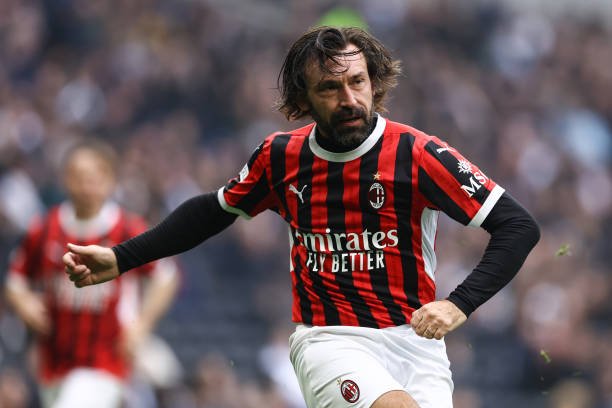
Andrea Pirlo Biography: How “Il Maestro” Redefined the Deep-Lying Playmaker
Few midfielders in football history have controlled the tempo of a match with as much calm authority as Andrea Pirlo. Born on 19 May 1979 in Flero, in the province of Brescia, Italy, Pirlo turned the deep-lying playmaker (regista) role into an art form, dictating games from in front of the defense with pinpoint long passes and devastating set-pieces (Wikipedia).
Across a glittering playing career spanning Brescia, Inter Milan, Reggina, AC Milan, Juventus, and New York City FC, Pirlo won six Serie A titles, two UEFA Champions League crowns, and the 2006 FIFA World Cup with Italy (Wikipedia; Lazio Stories). This Andrea Pirlo biography follows his transformation from a teenage attacking prodigy into one of football’s greatest tactical minds—both on the pitch and on the touchline.
Early Career: Brescia, Inter Milan, and the Regista Transformation (1992–2001)
Pirlo began his youth journey with Flero and Voluntas before joining local club Brescia in 1992, initially playing as a supporting forward and attacking midfielder (Wikipedia). On 21 May 1995, at just 16 years old, coach Mircea Lucescu handed him his Serie A debut against Reggiana, making Pirlo the youngest player ever to represent Brescia in Italy’s top flight (Wikipedia). After helping Brescia win the Serie B title in 1996–97, his talent earned him a move to Inter Milan in 1998 (Lazio Stories; Wikipedia).
Unable to lock down a regular starting spot at Inter, Pirlo spent the 1999–2000 season on loan at Reggina—where he made 30 league appearances and scored 6 goals—before returning to Brescia on loan for the second half of 2000–01 (Wikipedia; French Wikipedia). That loan proved to be the defining turning point of his career. Because Brescia already had Pirlo’s childhood idol Roberto Baggio in the number 10 role, manager Carlo Mazzone moved Pirlo deeper into midfield as a regista, unlocking his elite long-range passing vision—memorably showcased when Pirlo’s long ball set up Baggio’s late equalizer against Juventus on 1 April 2001 (Wikipedia).
The AC Milan Golden Decade (2001–2011)
On 30 June 2001, Inter’s city rivals AC Milan signed Pirlo for 33 billion Italian lire (€17,043,078) (Wikipedia). Over the next ten seasons, Pirlo became the beating heart of Carlo Ancelotti’s iconic Milan midfield, making 401 total appearances and scoring 41 goals in all competitions, including 284 Serie A appearances and 32 league goals (Wikipedia; StatMuse).
In 2002–03, Pirlo scored a career-best 9 Serie A goals and helped Milan win both the Coppa Italia and the UEFA Champions League, defeating Juventus on penalties in the final (Wikipedia). He followed that with his first Serie A title in 2003–04, the 2004 Supercoppa Italiana, and—after enduring the heartbreak of the 2005 Istanbul final—a second UEFA Champions League triumph in 2006–07 alongside two UEFA Super Cups (2003, 2007) and the 2007 FIFA Club World Cup (Wikipedia). Before departing in 2011, he added a second Scudetto with Milan in 2010–11 (Wikipedia).
Juventus Renaissance & MLS Finale (2011–2017)
When Pirlo joined Juventus on a free transfer in 2011, goalkeeper Gianluigi Buffon famously called it “the signing of the century” (Wikipedia). Pirlo immediately sparked a dynasty in Turin, helping Juventus win four consecutive Serie A titles from 2011–12 to 2014–15—including the 2013–14 campaign in which the Bianconeri set a league record of 102 points and 33 wins (Wikipedia; Lazio Stories).
Across four seasons in Turin, Pirlo recorded 164 total appearances and 19 goals, including 119 Serie A appearances, 16 goals, 29 assists, and 10,251 minutes played (French Wikipedia; StatMuse). He was voted Serie A Footballer of the Year three years in a row (2012, 2013, 2014), won the 2014–15 Coppa Italia, and reached the 2015 UEFA Champions League Final (Wikipedia; Lazio Stories). In 2015, he moved to Major League Soccer with New York City FC, logging 5,004 MLS minutes and earning an MLS All-Star selection in 2016 before retiring in 2017 (FootyStats; Wikipedia).
Italy National Team & 2006 World Cup Glory (2002–2015)
Making his senior debut in 2002 after winning the 2000 UEFA European Under-21 Championship, Pirlo went on to earn 116 caps and score 13 goals for Italy (Wikipedia; Goal). After captaining Italy to an Olympic bronze medal in 2004, he delivered a masterclass at the 2006 FIFA World Cup, winning the Bronze Ball and making the Team of the Tournament as the Azzurri lifted the trophy (Wikipedia). Six years later, he produced another iconic tournament run to guide Italy to the UEFA Euro 2012 final, earning a place in the 2012 UEFA Team of the Year (Wikipedia).
Coaching Career (2020–Present)
After retiring, Pirlo stepped straight into management. Appointed head coach of Juventus U23 in July 2020, he was promoted to the Juventus first-team job weeks later, winning both the Coppa Italia and Supercoppa Italiana during the 2020–21 season (Wikipedia; Lazio Stories). He subsequently managed Turkish Süper Lig club Fatih Karagümrük (2022–2023) and Italian Serie B side Sampdoria (2023–2024), before taking charge of United FC (Dubai United) in the United Arab Emirates in 2025, guiding the club to promotion into the UAE Pro League (Sofascore; Lazio Stories; Wikipedia).
My Take
If you want to understand Pirlo’s impact beyond elegance, look at his 2011–12 Serie A numbers for Juventus: he completed 2,643 passes at an 87% completion rate—500 more passes than any other player in Serie A, trailing only Xavi in world football—while creating over 100 chances and leading the league with 13 assists (Wikipedia).
Across 493 appearances in Europe’s top five leagues, StatMuse tracks 58 goals and 31 assists alongside 8 goals in the UEFA Champions League (StatMuse Career; StatMuse UCL). Just as lethal from dead balls as from open play, Pirlo scored 26 free-kick goals in Serie A—the second-highest total in Italian top-flight history behind Siniša Mihajlović (Lazio Stories). He didn’t need pace to dominate modern midfields; he solved the game two passes ahead of everyone else.
Frequently Asked Questions (FAQs)
How many appearances and goals did Andrea Pirlo have for AC Milan and Juventus? Pirlo made 401 appearances (41 goals) for AC Milan across all competitions and 164 appearances (19 goals) for Juventus (Wikipedia; French Wikipedia).
How many Serie A and Champions League titles did Andrea Pirlo win? As a player, Pirlo won six Serie A titles (two with AC Milan in 2004 and 2011; four with Juventus from 2012 to 2015) and two UEFA Champions League titles with AC Milan (2003 and 2007) (Lazio Stories; Wikipedia).
Who moved Andrea Pirlo to the deep-lying playmaker (regista) role? Coach Carlo Mazzone first deployed Pirlo as a deep-lying playmaker during Pirlo’s 2000–01 loan spell at Brescia, allowing him to play alongside Roberto Baggio (Wikipedia).
How many caps and goals did Andrea Pirlo have for Italy? Pirlo earned 116 caps and scored 13 goals for Italy, winning the 2006 FIFA World Cup and reaching the UEFA Euro 2012 final (Wikipedia; Goal).
Which teams has Andrea Pirlo coached? As a manager, Pirlo has coached Juventus U23, Juventus, Fatih Karagümrük, Sampdoria, and United FC (Dubai United) (Wikipedia; Sofascore).
Data From (Sources & References)
Biographical Profiles: Wikipedia — Andrea Pirlo, French Wikipedia — Andrea Pirlo, Lazio Stories — Andrea Pirlo, Goal — Italy & Pirlo Career Overview
Career Statistics & Match Logs: StatMuse — Andrea Pirlo Career Stats, StatMuse — Andrea Pirlo Stats with Milan, StatMuse — Andrea Pirlo Stats with Juventus, StatMuse — Andrea Pirlo Champions League Goals, FootyStats — Andrea Pirlo
Managerial Records: Sofascore — Andrea Pirlo Manager Profile


