
European Football Rules Explained: The Complete Beginner’s Guide for American Fans
European football rules explained for American fans who are tired of timeouts, confused by offside, and wondering why a 0-0 draw can feel like a thriller. This is not the NFL. There are no commercial breaks. The clock does not stop. And the team at the bottom of the table can be relegated at the end of the season.
If you are an American sports fan tuning into the Premier League, La Liga, or the Champions League for the first time, you will notice something immediately: the game never stops. No timeouts. No commercial breaks in the middle of a drive. No four-hour broadcast for 11 minutes of action.
European football is a different sport with a different rhythm. And once you understand the rules, it becomes the most gripping 90 minutes in sports.
Here is everything you need to know.
The Basics: 90 Minutes, 11 Players, and a Running Clock
A standard European football match lasts 90 minutes, divided into two 45-minute halves with a 15-minute halftime break . The clock runs continuously. It does not stop for injuries, substitutions, or goals.
Because the clock never stops, the referee adds stoppage time at the end of each half. You will see a board with “+3” or “+5” held up by the fourth official. That is how many extra minutes will be played .
Each team fields 11 players: 10 outfield players and 1 goalkeeper. In modern European leagues, teams are allowed up to five substitutions per match, made in three separate windows . Once a player is substituted off, they cannot return.
The points system is simple: a win earns 3 points, a draw earns 1 point, and a loss earns 0. Unlike American sports, regular-season games do not go to overtime. Ties are normal. Ties are accepted. And sometimes, a tie is the most tactical result of the weekend.
The Offside Rule: The One Rule Americans Always Ask About
Offside is the most debated rule in football. But the basic idea is simple: it stops attackers from camping near the opponent’s goal and waiting for an easy tap-in .
Here is how it works. An attacking player is in an offside position if, at the exact moment their teammate plays the ball, they are closer to the opponent’s goal line than both the ball and the second-to-last defender (usually the last outfield defender, since the goalkeeper is the last) .
Being in an offside position is not a foul by itself. It only becomes an offence if the player becomes actively involved in the play — touching the ball, interfering with an opponent, or clearly attempting to play a ball that is close .
And there are exceptions: you cannot be offside from a throw-in, and you cannot be offside if you are in your own half when the pass is played .
Fouls, Free Kicks, and Penalty Kicks
Football is a contact sport. But tripping, pushing, holding, or kicking an opponent is a foul. And outfield players are strictly forbidden from touching the ball with their hands or arms — that is a handball .
Direct free kick: Awarded for major fouls like tripping or handball. The ball can be kicked directly into the goal .
Indirect free kick: Awarded for minor infractions like offside or dangerous play. Another player must touch the ball before a goal can be scored .
Penalty kick: If a defender commits a direct-kick foul inside their own 18-yard box, the attacking team gets a penalty. It is a one-on-one shot from 12 yards out against only the goalkeeper .
Yellow Cards and Red Cards: The Discipline System
Referees use colored cards to keep the game safe and fair.
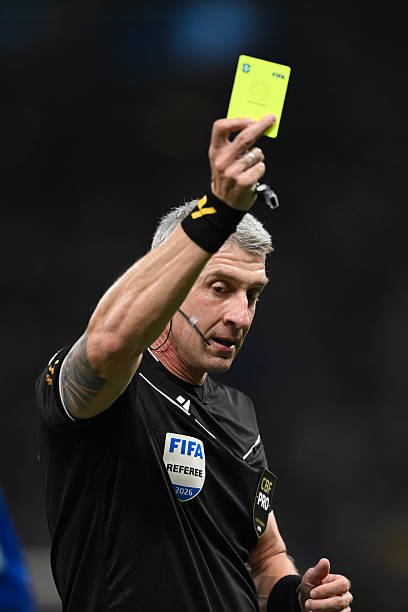
Yellow card (caution): An official warning. Given for reckless tackles, time-wasting, arguing with the referee, or persistent fouling .
Red card (ejection): Given for violent conduct, denying an obvious goal-scoring opportunity, or receiving two yellow cards in the same match. The player is ejected immediately, and their team cannot replace them — they must play the rest of the match down a player (10 vs. 11) .
VAR: The Video Assistant Referee
If you watch the NFL or NBA, you know instant replay. European football uses VAR (Video Assistant Referee).
A team of off-field referees watches the game on monitors and can alert the on-field referee to review “clear and obvious errors” in four specific situations :
Goals (checking for offside or fouls in the build-up)
Penalty kick decisions
Direct red card incidents
Mistaken identity (giving a card to the wrong player)
The final decision always remains with the on-field referee. VAR is a support tool, not a replacement .
Promotion and Relegation: The System That Makes Every Game Matter
This is the biggest shock for American sports fans. European football has no draft system and no closed leagues. It uses promotion and relegation .
Every country has a pyramid of leagues. In England, the Premier League is at the top, followed by the Championship, League One, and so on.
At the end of every season, the bottom three teams in the Premier League are relegated (demoted) to the Championship. Simultaneously, the top two teams from the Championship are promoted automatically, and the third promotion spot is decided by a playoff involving teams ranked 3rd to 6th .
This system means every single game matters — even for teams at the bottom of the standings fighting just to survive in the top division.
The Champions League: Europe’s Elite Competition
The UEFA Champions League is the biggest club competition in world football. It features the best teams from every European league.
The format changed in 2024/25. Instead of a traditional group stage, there is now a single 36-team league phase. Each team plays eight matches against eight different opponents. The top eight teams advance directly to the round of 16. Teams ranked 9th to 24th enter a knockout playoff round. Teams ranked 25th and below are eliminated .
The 2026/27 final will be played at the Estadio Metropolitano in Madrid on June 5, 2027 .
My Take: The Rules Are Simple. The Game Is Complex.
Everyone will tell you that football is simple. Kick the ball. Score a goal. Don’t use your hands. And they are right.
But the rules are not what makes football the most popular sport on the planet. The stakes are.
There is no draft. There is no safety net. If your team is bad, you do not get a high pick. You get relegated. You lose millions in revenue. You lose your best players. You disappear from the top flight.
That is why a 0-0 draw between two mid-table teams in November can feel like a war. That is why fans cry when their team survives on the final day. That is why the Premier League is the most-watched league in the world.
American sports are built on parity. European football is built on consequence. And once you understand that, you will never watch a game the same way again.
FAQs
Why is there no timeout in European football?
Football is designed to be a continuous test of endurance and strategy. Coaches cannot call timeouts. They shout instructions from the sidelines or pass notes onto the field during natural pauses like injuries or substitutions .
What happens if a knockout game ends in a tie?
Regular league games can end in a draw. Knockout matches must have a winner. If tied after 90 minutes, teams play 30 minutes of extra time (two 15-minute halves). If still tied, it goes to a penalty shootout .
Can a goalkeeper use their hands anywhere on the field?
No. A goalkeeper can only use their hands inside their own 18-yard penalty box. If they handle the ball outside that box, it is a handball foul and often results in a red card .
What is the offside rule in simple terms?
An attacker cannot be closer to the opponent’s goal than the second-to-last defender when the ball is played to them. If they are, and they become involved in the play, it is offside .
How does promotion and relegation work?
The bottom three teams in the Premier League are relegated to the Championship. The top two Championship teams are promoted automatically, and the third is decided by a playoff .
Data from:
Olympics.com. (2026, May 8). Fútbol: ¿Cómo se juega y cuáles son las reglas?
Olympics.com. (2021, May 10). Offside in football: Rules and how they work.
UEFA.com. (2026, September 9). 2026/27 Champions League: Teams, dates, draws, format, final.
Premier League. (2024, September 8). Offside Delaying the flag / Deliberate play / Interference.
UEFA.com. (2025, May 27). New Champions League format off to a flying start.


