
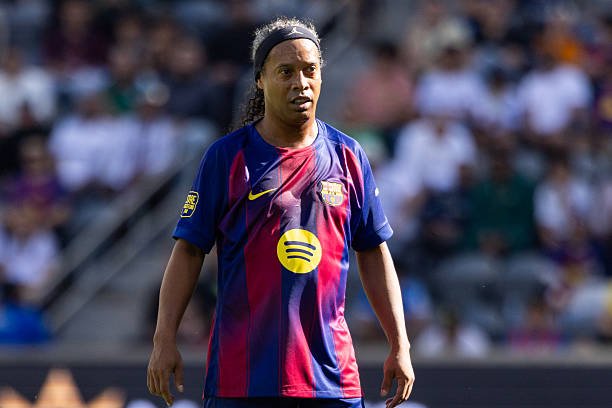
Ronaldinho Biography: From Porto Alegre to Football’s Greatest Entertainer
The Ronaldinho biography is a story of pure footballing joy backed by ruthless end product. Born Ronaldo de Assis Moreira on March 21, 1980, in Porto Alegre, Brazil (Britannica; Wikipedia), “Ronaldinho Gaúcho” revived FC Barcelona, won the 2005 Ballon d’Or, lifted the 2002 FIFA World Cup with Brazil, and conquered both Europe and South America’s biggest club competitions (FBref; FotMob).
Early Career: Grêmio & Paris Saint-Germain
Ronaldinho broke into senior football with Grêmio (1998–2001), winning the Campeonato Gaúcho and Copa do Brasil before moving to France with Paris Saint-Germain in 2001 (FotMob; Simple Wikipedia). At PSG, his dribbling and flair immediately stood out across Europe, setting the stage for a blockbuster move to Spain.
FC Barcelona: The Revival & 2005 Ballon d’Or
Joining FC Barcelona in the summer of 2003 at age 23, Ronaldinho became the catalyst for Barça’s return to the top of world football (FC Barcelona). He led Barcelona to back-to-back La Liga titles (2004–05 and 2005–06), two Supercopa de España trophies, and the 2005–06 UEFA Champions League crown (FotMob; FBref).
Individually, he was named FIFA World Player of the Year in both 2004 and 2005 and captured the 2005 Ballon d’Or (FBref).
Brazil Glory, AC Milan & South American Triumph
For Brazil, Ronaldinho earned 97 caps and scored 33 goals after debuting in June 1999 (SofaScore). He formed the iconic “3 Rs” front three alongside Ronaldo Nazário and Rivaldo to win the 2002 FIFA World Cup—famously scoring the quarter-final winner against England—and later lifted the 2005 Confederations Cup (Wikipedia; FotMob).
After leaving Barcelona in 2008, he starred for AC Milan before returning to the Americas with Flamengo, Atlético Mineiro—where he won the 2013 Copa Libertadores and was named South American Footballer of the Year—Querétaro, and Fluminense (Vedantu; FotMob; FBref).
My Take: The Efficiency Numbers Behind the Magic
People remember Ronaldinho for no-look passes, elastico dribbles, and standing ovations.
What the stats prove is that his showmanship never came at the expense of output. Even as a 21-year-old at PSG in 2001–02, he posted 0.80 goals and assists per 90 minutes in Ligue 1—split almost evenly between scoring (0.42) and creating (0.38) (FBref). At his 2005–06 Barcelona peak, he delivered 26 goals and 24 assists in 45 matches—a staggering 1.11 goal involvements per game (YouTube Stats Archive).
More remarkably, he is one of the rarest players in football history to win the FIFA World Cup (2002), the UEFA Champions League (2006), the Copa Libertadores (2013), and the Ballon d’Or (2005) (FBref; FotMob). Ronaldinho didn’t just entertain—he delivered elite production on two continents.
Frequently Asked Questions (FAQs)
What is Ronaldinho’s real name and when was he born? His full name is Ronaldo de Assis Moreira, and he was born on March 21, 1980, in Porto Alegre, Brazil (Britannica; Wikipedia).
How many Ballon d’Or awards did Ronaldinho win? He won one Ballon d’Or in 2005, alongside two FIFA World Player of the Year awards in 2004 and 2005 (FBref).
What major trophies did Ronaldinho win with Brazil and Barcelona? With Brazil, he won the 2002 FIFA World Cup and 2005 Confederations Cup; with FC Barcelona, he won two La Liga titles (2004–05, 2005–06) and the 2005–06 UEFA Champions League (FotMob).
How many goals did Ronaldinho score for Brazil? He scored 33 goals in 97 senior international appearances for Brazil (SofaScore).
Data From (Sources & References)
All career milestones, trophies, international totals, and historical stats in this biography were compiled and verified from the following official and sports-data sources:
Biography & Club Legacy: Encyclopaedia Britannica (Ronaldinho), Wikipedia (Ronaldinho), and FC Barcelona Official Legends Profile
Career Stats, Honours & Per-90 Analytics: FBref (Ronaldinho Stats & Honours), FotMob (Career Trophies), and SofaScore (Brazil Caps & Goals)


